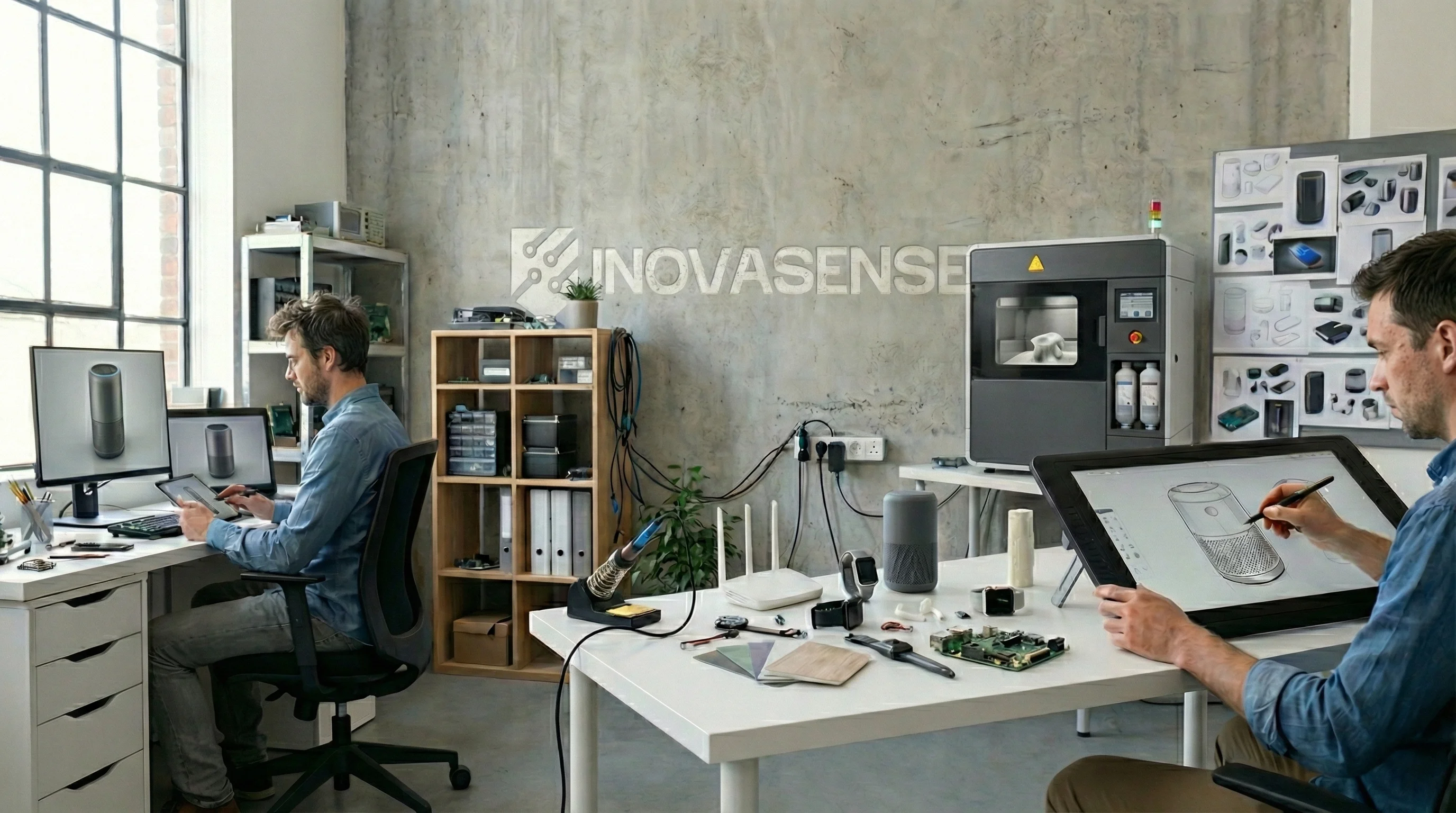
Industrial Design & Mechanical Engineering
What is Industrial Design for Electronics?
Industrial Design for Electronics merges aesthetics with rugged engineering. It involves creating functional enclosures that manage thermal dissipation (CFD), ensure EMC shielding, and provide IP67/68 ingress protection. This approach ensures hardware reliability in harsh environments while complying with the EU Ecodesign Regulation.
We design the physical reality of your electronic product. From thermal management of high-power FPGAs to IP68 ruggedized enclosures for defense — ensuring your hardware survives the real world.
Mechanical Engineering for Electronics
Electronics do not exist in a vacuum. They generate heat, emit EMI, and face vibration. Our mechanical engineers work alongside PCB designers in Altium + SolidWorks co-design workflows to ensure fit, function, and manufacturability from day one.
- Thermal Simulation (CFD): Active and passive cooling strategies for Edge AI nodes and high-performance FPGA computing. We simulate airflow and heat dissipation before cutting metal.
- EMC Shielding: Custom machined aluminum housings and conductive gaskets to meet EN 55032 Class B emission standards.
- Ruggedization: Shock and vibration damping for MIL-STD-810H defense compliance.
DFM & Tooling Management
A beautiful render is useless if it cannot be manufactured. We bridge the gap between industrial design and the injection molding factory.
- Design for Manufacture (DFM): Draft angle analysis, wall thickness optimization, and snap-fit engineering to maximize yield and minimize cycle time.
- Mold Flow Analysis: Preventing sink marks, weld lines, and warpage in plastic parts.
- Tooling Oversight: We manage the entire tooling process (T0/T1/T2 trials) with our EU or vetted global partners, ensuring the final part matches the CAD file.
Sustainability & Ecodesign
Aligned with the EU Ecodesign for Sustainable Products Regulation (ESPR), we design for repairability and recyclability.
- Right-to-Repair: Enclosures designed for non-destructive opening (screws not glue).
- Material Selection: PC/ABS, Aluminum 6061, and bio-composites with full material traceability.
- Digital Product Passport: Mechanical integration of QR/NFC tags for lifecycle tracking.
Capabilities
| Domain | Specification |
|---|---|
| CAD Software | SolidWorks, Autodesk Fusion 360, Rhino |
| Ingress Protection | IP65, IP67, IP68 (Submersible) |
| Impact Protection | IK08 to IK10 (Vandal resistant) |
| Materials | Injection Molded Plastics, CNC Aluminum, Sheet Metal, 3D Print (SLA/SLS) |
| Compliance | RoHS, REACH, WEEE, Ecodesign |
“The enclosure is the first thing your customer touches. It must convey the quality of the engineering inside.”
Frequently Asked Questions
Do you provide enclosure design for electronics?
Yes. We offer full mechanical engineering and industrial design services, specializing in ruggedized (IP67/68), EMC-shielded, and thermally optimized enclosures for industrial and defense electronics.
What is the difference between Industrial Design and Mechanical Engineering?
Industrial Design focuses on usability, aesthetics, and ergonomics (how it looks and feels). Mechanical Engineering ensures structural integrity, thermal performance, manufacturability, and ingress protection (how it works and survives).
Do you handle injection molding tooling?
Yes. We manage the entire tooling process, from DFM (Design for Manufacture) analysis and mold flow simulation to T0/T1 trials and final texture approval, ensuring the produced parts match the design intent perfectly.