What is EN 18031?
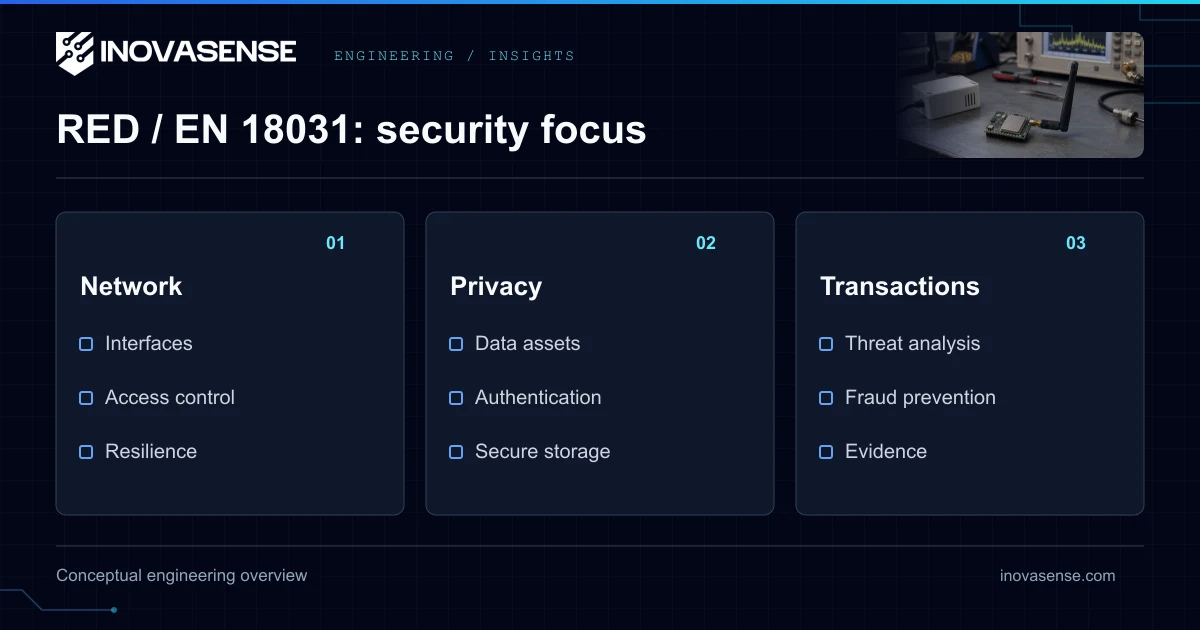
EN 18031 is a series of three harmonized standards, EN 18031-1, -2 and -3, for the cybersecurity of radio equipment. It is the voluntary route to a presumption of conformity with Articles 3.3(d), (e), and (f) of the Radio Equipment Directive (2014/53/EU): protection of the network, of personal data and privacy, and from fraud. The RED Delegated Act (Commission Delegated Regulation EU 2022/30) made these requirements mandatory for internet-connected radio equipment placed on the EU market since August 1, 2025; the Delegated Act is repealed from December 11, 2027, when the Cyber Resilience Act applies in full. Non-compliance means products cannot legally bear the CE mark for radio equipment.
EN 18031 at a Glance: Which Part Applies
| Part and requirement | Applies to | Where the presumption of conformity is restricted |
|---|---|---|
| EN 18031-1: Article 3.3(d), protection of the network | Radio equipment that can communicate over the internet, directly or through other equipment | Where the device allows the user not to set and use a password (clauses 6.2.5.1 and 6.2.5.2) |
| EN 18031-2: Article 3.3(e), personal data and privacy | Radio equipment that processes personal, traffic or location data and is internet-connected, childcare equipment, a toy or a wearable | As in Part 1, and for toys and childcare equipment without parental or guardian access control (clauses 6.1.3 to 6.1.6) |
| EN 18031-3: Article 3.3(f), protection from fraud | Internet-connected radio equipment that enables transfers of money, monetary value or virtual currency | As in Part 1, and the secure-update assessment criteria of clause 6.3.2.4 never confer it |
One product can fall under more than one part: an internet-connected payment wearable falls under all three. In every part, the sections named “rationale” and “guidance” carry no presumption of conformity.
Can You Self-Declare Under EN 18031?
Yes, where every part that applies to the product is applied in full and none of the restrictions in the table is met. The manufacturer then uses internal production control (Module A) and issues the EU Declaration of Conformity without a notified body. Where a restriction is met, or a part is applied only partly or not at all, RED Article 17(4) requires a notified body for those requirements: EU-type examination followed by conformity to type (Modules B+C), or full quality assurance (Module H). For products under EN 18031-3 the secure-update criteria give no presumption in any case, so a notified body has to assess the update solution.
What the assessment itself involves, mechanism by mechanism, is covered in EN 18031 self-assessment: what Module A actually requires.
The Regulatory Context: What Changed
The Radio Equipment Directive (RED) has contained Articles 3.3(d), (e), and (f) since 2014. These articles define protection requirements for networks, personal data, and fraud prevention. For ten years, they were dormant — Article 3.3 requirements apply only to the categories or classes of radio equipment that the Commission specifies by delegated act.
The RED Delegated Act (EU 2022/30) changes that. From August 1, 2025, these requirements are mandatory for all radio equipment that can connect to the internet — directly or through a gateway.
The date was delayed once: the original deadline was August 2024, postponed to allow time for the harmonized standards — EN 18031-1/-2/-3:2024, cited in the Official Journal with restrictions on January 30, 2025. Delegated Regulation (EU) 2026/339 repeals the Delegated Act with effect from December 11, 2027, when the CRA applies in full. The repeal does not end market surveillance of equipment already placed on the market: according to recital 5 of that regulation, radio equipment placed on the market between August 1, 2025 and December 10, 2027 remains subject to market surveillance under the RED for these requirements.
The citation in the Official Journal (Implementing Decision (EU) 2025/138) carries four restrictions on the presumption of conformity. First, the sections of the standards named “rationale” and “guidance” do not confer it, in any of the three parts. Second, it is lost where the device allows the user not to set and use a password (clauses 6.2.5.1 and 6.2.5.2 of all three parts). Third, it is lost for toys and childcare equipment where parental or guardian access control is not ensured (EN 18031-2 clauses 6.1.3 to 6.1.6). Fourth, the secure-update assessment criteria of EN 18031-3 clause 6.3.2.4 do not confer it in any case.
Relationship to CE marking: Under the CE marking framework, EN 18031 is the harmonized standard cited in the Official Journal for these requirements. Applying it is voluntary, but a manufacturer that does not apply it in full must involve a notified body (RED Article 17(4)). The Declaration of Conformity must be backed by evidence for Articles 3.3(d)(e)(f) in the Technical File.
Who Is Affected
If your product has any wireless interface and can — directly or through a connected device — reach the internet, it is in scope:
| Device Type | In Scope? |
|---|---|
| Wi-Fi-enabled devices (all categories) | ✅ Yes |
| Bluetooth devices that relay through a smartphone or hub | ✅ Yes |
| Cellular IoT (LTE-M, NB-IoT, Cat-1) | ✅ Yes |
| Smart home sensors, gateways, hubs | ✅ Yes |
| Wearables (smartwatches, fitness trackers, health monitors) | ✅ Yes |
| Baby monitors, childcare cameras | ✅ Yes |
| Wireless payment terminals | ✅ Yes (also EN 18031-3) |
| Zigbee/Z-Wave devices connected to an internet gateway | ✅ Yes |
| Standalone Bluetooth device with no data path to internet | Outside points (d) and (f); point (e) still applies to toys, childcare equipment and wearables that can process personal, traffic or location data |
Important: The scope is “internet-connected radio equipment” — not just consumer products. Industrial IoT, connected medical accessories (not MDR-classified), smart building sensors, and logistics trackers are all in scope if they have a wireless interface with an internet data path.
Exclusions (Article 2 of the Delegated Act): Radio equipment that is also covered by the medical device regulations (Regulations (EU) 2017/745 and 2017/746) is exempt from all three requirements. Radio equipment that is also covered by the civil aviation regulation (Regulation (EU) 2018/1139), the vehicle type-approval regulation (Regulation (EU) 2019/2144) or the directive on electronic road toll systems (Directive (EU) 2019/520) is exempt only from points (e) and (f); point (d), protection of the network, still applies to it.
What EN 18031 Actually Requires
The harmonized standard series EN 18031 consists of three parts, each mapping to one essential requirement of RED Article 3.3: points (d), (e) and (f).
EN 18031-1 — Network Protection (Art. 3.3(d))
The device must not harm the network or misuse network resources. In practice:
- Exposed interfaces and services — In the factory default state the device may expose only the network interfaces and services needed for setup or basic operation (GEC-2). Optional ones must be switchable on and off by an authorised user (GEC-3), and physical external interfaces are allowed only where the intended function needs them (GEC-5). An open telnet service, unprotected MQTT or an open debug port has to be justified against these requirements.
- Resilience — The device must mitigate the effects of denial-of-service attacks on its network interfaces and return to a defined state afterwards (RLM-1). Network equipment such as routers must also monitor traffic for signs of such attacks and provide traffic control (NMM-1, TCM-1).
- Secure updates [SUM-2] — The device may install only software whose integrity and authenticity are valid at the time of installation. The standard is technology-neutral and names four implementation categories: digital signatures on updates by authorised entities, a secure communication mechanism to the authorised update source, access control combined with a hash-protected update, and a generic category for other methods. EN 18031-1 and -2 say nothing about verification at boot; SUM-2 concerns the moment an update is installed. Verified boot from a hardware root of trust is our engineering recommendation for these products, not a requirement of the standard. For products under EN 18031-3 it is a requirement (clause 6.8.8, see below).
Technical File implication: For each update mechanism the standard asks for a description, the signature scheme or other method with the cryptography behind it, and the chosen path through the decision tree with its justification. The test then confirms that unsigned, altered and wrongly signed updates are not installed. Describe signing-key management as well; the verification key stored on the device falls under the storage requirements (SSM-2).
EN 18031-2 — Privacy Protection (Art. 3.3(e))
The device must protect personal data and user privacy. It applies to radio equipment that processes personal, traffic or location data and is internet-connected, childcare equipment, a toy or a wearable.
- Secure storage (SSM) — Persistently stored security assets and privacy assets, keys among them, must be protected by a secure storage mechanism, unless the operating environment itself limits access to authorised entities. The requirement is in all three parts, not only in Part 2. The standard names implementation categories, not products: for confidentiality these are encryption, access control, hardware protection and a generic category. ARM TrustZone with a key management service, an external Secure Element (e.g., ATECC608C, STSAFE-A, SE050) or OTP/eFuse-based key storage are typical ways to implement the hardware categories. Software-based storage is an equal category: whichever one is used, the mechanism must be described and justified, and the test checks that unauthorised reading and modification are not possible. Hardware-based storage is our recommendation; the standard treats it as one category among several.
- No universal default passwords — A factory default password must be unique per unit and follow best practice for strength, or the user must be forced to change it before or on first use (AUM-5-1). This also applies in all three parts.
- Deletion, notification, logging — EN 18031-2 adds a mechanism for the user to delete personal data (DLM-1), notifications about changes that affect privacy (UNM-1, UNM-2), logging of privacy-relevant events (LGM-1 to LGM-4) and a duty to document sensing capabilities, for example a microphone or camera, for the user (GEC-7). Data minimisation is a GDPR principle, not an EN 18031-2 requirement.
- Toys and childcare equipment — For toys, and in one clause also childcare equipment, EN 18031-2 requires restrictive defaults (children’s access to external content, third-party access to children’s data) and access control that a parent or guardian can configure (ACM-3 to ACM-6).
Hardware implication: Wi-Fi credentials and device keys kept in plain flash, for example in unencrypted ESP32 NVS, with no encryption, access control or hardware protection will not pass the confidentiality requirement (SSM-3), unless the manufacturer can justify the SSM-1 exception: the operating environment itself limits access to authorised entities.
EN 18031-3 — Fraud Prevention (Art. 3.3(f))
Applies to devices that handle financial transactions, monetary value, or virtual currency:
- Secure updates without presumption of conformity — EN 18031-3 lists the same implementation categories for secure updates as the other parts (digital signatures, secure communication, access control with hash, other methods). The Commission considers none of them sufficient on its own for equipment handling financial assets, so the assessment criteria of clause 6.3.2.4 give no presumption of conformity and a notified body must assess the solution.
- Boot verification from a root of trust (GEC-8) — Independently of the update clause, clause 6.8.8 requires equipment that processes financial data to verify cryptographically, at boot, the integrity and authenticity of the software that handles financial and security assets. The root of trust must be immutable, or changeable only under cryptographically authenticated authorisation; in practice this means a hardware root of trust. A signature check whose verifier can itself be replaced does not meet this.
- Two-factor authentication — Access through a user interface over a network to financial functions that transfer money, monetary assets or virtual currency requires two factors (AUM-2-2). Machine interfaces that can read or modify financial data need authentication too (AUM-1-3).
- Logging — Events relevant to financial assets and their protection must be logged (LGM-1 to LGM-4). Replay protection (SCM-4) and input validation (GEC-6), which all three parts contain, apply here to financial assets.
Who this affects: Connected point-of-sale terminals, e-wallet wearables, mobile payment accessories, cryptocurrency hardware wallets, smart meters with prepayment functionality.
Hardware Decisions You Cannot Patch
This is the section most teams miss. EN 18031 does not prescribe silicon, but several of its mechanisms are far easier to implement and to defend with the right hardware, and for EN 18031-3 products boot verification from a root of trust is mandatory (clause 6.8.8). These are silicon-level architecture decisions that cannot be retrofitted in firmware:
| Security capability | Hardware Decision | MCUs That Support It |
|---|---|---|
| Hardware Secure Boot (required by EN 18031-3 clause 6.8.8; our recommendation under Parts 1 and 2) | Immutable first-stage bootloader (ROM or write-protected flash) + eFuse/OTP key storage | STM32U5, nRF5340, ESP32-S3, i.MX RT1170, STM32H5 |
| Hardware key isolation (one of several accepted storage categories) | TrustZone or Secure Element | ARM Cortex-M33+, ATECC608C, SE050, STSAFE-A |
| Rollback protection (best practice, not normative — EN 18031-1 clause 6.3.2.3, SUM-2 guidance) | Hardware monotonic counter (OTP/eFuse) or secure version counter | nRF9160, STM32H5, ESP32-S3, STM32WBA |
| Per-device unique credentials (AUM-5-1 for default passwords, CCK-3 for preinstalled keys) | Manufacturing provisioning infrastructure | Typically eFuse burning or SE provisioning at production |
| Entropy source for key generation (CCK-2: generation according to best-practice cryptography) | On-chip true random number generator | Most modern MCUs — verify in datasheet |
Legacy warning: STM32F4, STM32F7, and similar older Cortex-M4/M7 parts without TrustZone have limited Secure Boot support. Designs based on these chips may need a board revision, not a firmware update, to reach a defensible implementation, and for EN 18031-3 products to meet clause 6.8.8. If you are designing on these platforms, we recommend an architecture review before committing to manufacturing.
The National Enforcement Reality
The Delegated Act is EU law, enforced by the market surveillance authority of each member state. Four examples:
🇩🇪 Germany — Bundesnetzagentur (BNetzA) The BNetzA is the market surveillance authority for radio equipment in Germany. It checks samples of products by reviewing the documentation and, where indicated, through physical checks and laboratory tests; it also monitors online sales.
🇫🇷 France — ANFR The ANFR (Agence nationale des fréquences) carries out market surveillance of radio equipment under the RED. Its measures range from a formal notice to bring products into conformity to suspension of sales, recalls and administrative fines.
🇳🇱 Netherlands — RDI (Dutch Authority for Digital Infrastructure) The RDI is the Dutch state inspectorate that covers the RED rules for placing radio equipment on the market. The Netherlands is a major port of entry for goods bound for the EU market.
🇸🇪 Sweden — PTS (Post and Telecom Authority) PTS carries out market surveillance of products with radio components in Sweden. It selects products according to a sampling plan or after a complaint, can buy them anonymously for testing, and can ban sales or order a recall.
Practical consequence: Non-compliance found by a national authority can lead to corrective action or market withdrawal. Measures are shared with other member states through the EU information and communication system for market surveillance (Regulation (EU) 2019/1020, Article 34); products presenting a serious risk are also notified through Safety Gate / RAPEX. At the border, customs suspend the release for free circulation of products that lack the required documentation or marking (Regulation (EU) 2019/1020, Article 26). Under Article 40 of the RED, a restrictive measure taken by one member state that meets no objection within three months is deemed justified, and the other member states must then act on the same equipment.
The CRA Relationship
The RED Delegated Act and the Cyber Resilience Act (CRA) (EU 2024/2847) overlap in scope for connected hardware:
| Aspect | RED Delegated Act | CRA |
|---|---|---|
| Applies from | August 1, 2025 (repealed from December 11, 2027) | December 11, 2027 (reporting: September 11, 2026) |
| Scope | Internet-connected radio equipment | Products with digital elements |
| Standard | EN 18031-1/2/3 | CRA harmonized standards in preparation (request M/606) |
| SBOM required | No | Yes |
| Vulnerability reporting | No | Yes (since Sep 11, 2026: 24h early warning to the coordinating CSIRT and ENISA) |
| Relationship | Repealed from December 11, 2027 by Delegated Regulation (EU) 2026/339 | Broader; its Annex I covers the RED Article 3.3(d)(e)(f) requirements |
Practical implication: EN 18031 compliance today gives you the security hardware foundation for CRA readiness in 2027. Apart from a check for publicly known exploitable vulnerabilities at the time of assessment (GEC-1), it does not cover SBOM, vulnerability handling, or lifecycle obligations — those are CRA-specific additions. See our CRA hardware compliance checklist for the full CRA requirements.
The Compliance Checklist
For any internet-connected radio product currently on the EU market or in active development:
Scope:
- Confirm the product has an internet data path (direct or via gateway)
- Identify which EN 18031 parts apply (18031-1 always; -2 if personal data; -3 if payments)
Hardware:
- Update verification (SUM-2): integrity and authenticity checked at installation, method documented
- Boot verification: required for EN 18031-3 products (clause 6.8.8, root of trust); recommended otherwise
- Key storage (SSM): TrustZone + key service, Secure Element, OTP/eFuse, or software-based (encryption, access control), with the mechanism described and justified in the Technical File
- Anti-rollback (best practice): hardware monotonic counter present and integrated
- Default password: unique per device with best-practice strength, or forced change on first use
- Key generation (CCK-2): entropy source confirmed, hardware random number generator in silicon or external
Documentation:
- Technical File updated with EN 18031-x test evidence
- EU Declaration of Conformity updated with the references of the EN 18031 parts applied (RED Annex VI, point 6)
- EN 18031 conformity assessment path confirmed — self-declaration (Module A) is permitted for most devices; specific product characteristics (password bypass mechanisms, children’s devices, payment functionality) may trigger a notified body requirement. Verify against the applicable clauses for your specific product.
If any hardware items are gaps today, you have a board respin decision to make. The requirements have applied to every unit placed on the EU market since August 1, 2025.
About the Author
Vladimir Vician is the founder of Inovasense, an EU-based embedded hardware and compliance engineering company. With over 10 years of experience in embedded hardware design, he works with hardware manufacturers on complete EU regulatory compliance — from silicon selection and Technical File preparation to CE marking and CRA readiness. He is the author of the MCU vs MPU Architecture Advisor tool.
Connect on LinkedIn · Inovasense Embedded Security & IoT
Official References
Clause references to EN 18031-1, -2 and -3:2024 were checked against the full text of the standards on November 13, 2026. The standards are paid documents and are not linked here.
- Commission Delegated Regulation (EU) 2022/30 — RED Delegated Act full text — EUR-Lex
- Commission Implementing Decision (EU) 2025/138 — citation of EN 18031-1, -2 and -3 with restrictions — EUR-Lex
- Commission Delegated Regulation (EU) 2026/339 — repeal of the RED Delegated Act from December 11, 2027 — EUR-Lex
- Directive 2014/53/EU (RED) — Base directive — EUR-Lex
- European Commission — Radio Equipment Directive page (Articles 3.3(d)(e)(f) section) — European Commission
- European Commission press release — Commission strengthens cybersecurity of wireless devices (Oct 2021) — European Commission
- ADCO RED — Administrative Cooperation Group for RED — European Commission
Frequently Asked Questions
What is EN 18031?
EN 18031 is a series of three harmonised standards, EN 18031-1, -2 and -3:2024, developed by CEN-CENELEC JTC 13 for the cybersecurity of radio equipment. Part 1 covers protection of the network (RED Article 3.3(d)), Part 2 protection of personal data and privacy (Article 3.3(e)) and Part 3 protection from fraud (Article 3.3(f)). The series was cited in the Official Journal on January 30, 2025 with restrictions. Applied in full and within those restrictions, it gives a presumption of conformity with requirements that have applied since August 1, 2025.
What is the RED Delegated Act and when does it apply?
The RED Delegated Act (Commission Delegated Regulation EU 2022/30) activates the cybersecurity requirements in Articles 3.3(d), (e), and (f) of the Radio Equipment Directive for internet-connected radio equipment and certain childcare, toy and wearable radio equipment placed on the EU market. It has applied since August 1, 2025 and is repealed with effect from December 11, 2027, when the Cyber Resilience Act applies in full (Delegated Regulation EU 2026/339). The harmonized standard EN 18031 is the voluntary route to a presumption of conformity.
Does EN 18031 apply to my product if I already have a RED certificate?
A conformity assessment under RED Articles 3.1 and 3.2 covers safety, EMC and radio spectrum requirements. The Delegated Act adds Article 3.3(d)(e)(f) cybersecurity requirements — these are separate tests. Your existing RED conformity assessment does not automatically demonstrate EN 18031 compliance. You must update your Technical File and Declaration of Conformity.
Which products are in scope for the RED Delegated Act?
All radio equipment that can connect to the internet — directly or indirectly through a gateway or smartphone. This includes Wi-Fi devices, Bluetooth IoT devices, cellular IoT (LTE-M, NB-IoT), smart home devices, wearables, baby monitors, and wireless payment terminals. Industrial IoT is also in scope if it has an internet data path. Toys, childcare equipment and wearables that can process personal, traffic or location data fall under point (e) even without an internet connection.
What are the hardware requirements of EN 18031?
EN 18031 is technology-neutral and prescribes no particular chip. All three parts require access control and authentication for access to protected assets, an update mechanism that installs only software whose integrity and authenticity are valid at installation, secure storage for persistently stored security assets, and factory default passwords that are unique per device or must be changed on first use. Hardware-based key storage (TrustZone, Secure Element, OTP/eFuse) is one accepted implementation category among several: we recommend it, the standard does not require it. Verification at boot is not mentioned in EN 18031-1 or -2, but EN 18031-3 requires it for equipment that processes financial data (clause 6.8.8). The secure-update assessment criteria of EN 18031-3 (clause 6.3.2.4) give no presumption of conformity, so a notified body is involved. Several of these choices trace to silicon decisions that are hard to change once the board is designed.
Can I self-certify for the RED Delegated Act / EN 18031?
For most radio equipment, manufacturers can self-declare conformity (Module A) by testing to EN 18031 and issuing an EU Declaration of Conformity that lists the EN 18031 parts applied. However, a notified body (Module B+C or H) is required where the standard gives no presumption of conformity: if the device allows users not to set and use a password (clauses 6.2.5.1/6.2.5.2 of all three parts), if parental or guardian access control is not ensured on toys and childcare equipment (EN 18031-2 clauses 6.1.3–6.1.6), and for the secure-update assessment criteria of EN 18031-3 clause 6.3.2.4, which are excluded from the presumption in every case. Always verify against the specific clauses applicable to your product.
How does the RED Delegated Act relate to the EU Cyber Resilience Act?
The RED Delegated Act has applied since August 2025 and covers cybersecurity for internet-connected radio equipment, with EN 18031 as the harmonized standard. The CRA is broader — it covers products with digital elements and adds SBOM requirements, vulnerability reporting (since September 2026), and support-period obligations; its main requirements apply from December 11, 2027, the date from which the RED Delegated Act is repealed (Delegated Regulation EU 2026/339). EN 18031 compliance today provides the hardware security foundation for CRA readiness.
Which MCUs support hardware Secure Boot for EN 18031 designs?
MCUs with silicon-level hardware Secure Boot include: STM32U5, STM32H5, STM32WBA (STMicroelectronics); nRF5340, nRF9160 (Nordic Semiconductor); ESP32-S3 (Espressif); i.MX RT1170 (NXP). Legacy MCUs such as STM32F4 and STM32F7 (Cortex-M4/M7 without TrustZone) have limited Secure Boot support and may require board design changes.