
What is CRA vulnerability reporting?
From September 11, 2026, all manufacturers of products with digital elements sold in the EU must report actively exploited vulnerabilities and severe security incidents to ENISA via the Single Reporting Platform (SRP). This obligation is defined in Article 14 of Regulation (EU) 2024/2847 (the Cyber Resilience Act). Manufacturers must submit an early warning within 24 hours, a detailed notification within 72 hours, and a final report within 14 days after a patch is available. Non-compliance carries fines up to €15 million or 2.5% of global turnover. This guide explains exactly how to prepare.
Why This Is the First CRA Deadline That Hits You
Article 14 reporting obligations are the first operational requirement of the Cyber Resilience Act. While the full CRA enforcement date is December 11, 2027, Article 71(2) explicitly states:
“Article 14 shall apply from 11 September 2026.” — Regulation (EU) 2024/2847, Article 71(2)
This means that four months from now, every manufacturer selling a connected product in the EU must have a functioning vulnerability reporting process — even if the product itself was placed on the market years ago.
| CRA Milestone | Date | Legal Basis |
|---|---|---|
| CRA enters into force | December 10, 2024 | Art. 71(1) |
| Conformity assessment bodies activated | June 11, 2026 | Art. 71(2) |
| Vulnerability reporting obligation | September 11, 2026 | Art. 71(2) — Art. 14 applies |
| Full enforcement (all requirements) | December 11, 2027 | Art. 71(2) |
What Must Be Reported
Article 14 defines two distinct categories of reportable events. Understanding the difference is critical — the reporting timelines differ.
1. Actively Exploited Vulnerabilities (Article 14(1))
A vulnerability that the manufacturer becomes aware is being actively exploited in any of its products with digital elements currently available on the EU market.
Key definition: The regulation does not define a minimum severity threshold. If you become aware that a vulnerability in your product is being actively exploited — regardless of CVSS score — you must report it.
2. Severe Security Incidents (Article 14(3))
An incident having an impact on the security of the product with digital elements. Article 14(5) defines “severe” as an incident that:
- (a) negatively affects or is capable of negatively affecting the ability of a product to protect the availability, authenticity, integrity, or confidentiality of sensitive or important data or functions; or
- (b) has led or is capable of leading to the introduction or execution of malicious code in a product or in the network and information systems of a user.
Practical note: The “or” conjunction means that a supply chain compromise affecting your firmware — even if no end-user device has been confirmed infected — likely qualifies as a severe incident under criterion (b).
The Three-Stage Reporting Timeline
Both vulnerability and incident reporting follow a mandatory three-stage process. Each stage has a legally binding deadline measured from the moment you become aware of the event.
Actively Exploited Vulnerabilities
| Stage | Deadline | Content Required | Legal Basis |
|---|---|---|---|
| Early Warning | Within 24 hours | Notification that an actively exploited vulnerability exists; indicate Member States where the product has been made available | Art. 14(2)(a) |
| Vulnerability Notification | Within 72 hours | General product information, nature of the exploit and vulnerability, corrective/mitigating measures taken, measures users can take, sensitivity indication | Art. 14(2)(b) |
| Final Report | Within 14 days after a corrective or mitigating measure is available | Description of the vulnerability (severity, impact), information about malicious actors (if available), details of the security update or corrective measures | Art. 14(2)(c) |
Severe Security Incidents
| Stage | Deadline | Content Required | Legal Basis |
|---|---|---|---|
| Early Warning | Within 24 hours | Notification of the incident, whether suspected unlawful/malicious acts, affected Member States | Art. 14(4)(a) |
| Incident Notification | Within 72 hours | Nature of the incident, initial assessment, corrective/mitigating measures, sensitivity indication | Art. 14(4)(b) |
| Final Report | Within 1 month after the 72-hour notification | Detailed description (severity, impact), threat type or root cause, applied and ongoing mitigation measures | Art. 14(4)(c) |
Critical distinction: For vulnerabilities, the 14-day final report clock starts when a patch or mitigating measure becomes available — not when you first become aware. For incidents, the one-month clock starts from the 72-hour notification submission date.
Where to Report: The ENISA Single Reporting Platform
Article 16 establishes a Single Reporting Platform (SRP) managed by ENISA. This is the mandatory channel — email, phone, or informal communication does not satisfy the legal requirement.
How the SRP Works
- ENISA manages the platform — day-to-day operations, security, and maintenance (Art. 16(1))
- Each Member State has its own electronic notification end-point — you submit through the end-point of the CSIRT designated as coordinator for the Member State of your main establishment in the Union (Art. 14(7))
- Simultaneous access for ENISA — your submission is automatically accessible to both your national CSIRT coordinator and ENISA (Art. 14(7))
- Automatic dissemination — the receiving CSIRT disseminates the notification to other affected Member States’ CSIRTs via the SRP (Art. 16(2))
Determining Your CSIRT Coordinator
Article 14(7) provides clear rules for determining which CSIRT receives your notifications:
- EU-established manufacturer: The CSIRT of the Member State where your main establishment is located — defined as where decisions related to cybersecurity of your products are predominantly taken
- Non-EU manufacturer with EU presence: Priority order: (a) the Member State of your authorized representative covering most products, (b) the Member State of your primary importer, (c) the Member State of your primary distributor, (d) the Member State with the most users
CSIRT Coordinators — Central Europe Quick Reference
For manufacturers based in Central Europe, here are the designated national CSIRTs to which you will submit CRA reports via the ENISA Single Reporting Platform:
| Country | CSIRT Coordinator | Website | Parent Authority |
|---|---|---|---|
| 🇸🇰 Slovakia | SK-CERT | sk-cert.sk | National Security Authority (NBÚ) |
| 🇨🇿 Czech Republic | NÚKIB CERT | nukib.cz | National Cyber and Information Security Agency |
| 🇵🇱 Poland | CERT Polska | cert.pl | NASK (Research and Academic Computer Network) |
| 🇭🇺 Hungary | NKI | nki.gov.hu | National Cybersecurity Institute |
| 🇦🇹 Austria | CERT.at | cert.at | GovCERT Austria |
| 🇩🇪 Germany | CERT-Bund | bsi.bund.de | Federal Office for Information Security (BSI) |
| 🇪🇺 EU Institutions | CERT-EU | cert.europa.eu | EU Cybersecurity Service |
How to identify your coordinator: Under Article 14(7), you submit to the CSIRT of the Member State where your main establishment is located — defined as where cybersecurity decisions for your products are predominantly made. For the complete list of all 27 EU Member State CSIRTs, see the EU CSIRTs Network directory.
Penalties for Non-Compliance
Article 64 of the CRA establishes a three-tier penalty structure. Article 14 violations fall under the most severe category:
| Violation | Maximum Fine | Legal Basis |
|---|---|---|
| Failure to report under Article 14 | €15 million or 2.5% of global annual turnover (whichever higher) | Art. 64(2) |
| Other CRA compliance failures | €10 million or 2% of global turnover | Art. 64(3) |
| Supplying incorrect information | €5 million or 1% of global turnover | Art. 64(4) |
SME Exception
Article 64(10)(a) provides a limited exception: microenterprises and small enterprises are exempt from administrative fines for failing to meet the 24-hour early warning deadline (Art. 14(2)(a) and Art. 14(4)(a)). However, they are not exempt from the remaining reporting obligations (72-hour notification and final report).
Important: This exemption applies only to the 24-hour deadline. It does not exempt SMEs from the obligation to report — only from the fine for missing the specific 24-hour timeline.
What Your Company Must Build Before September 2026
Meeting the 24-hour early warning deadline requires operational infrastructure that cannot be built overnight. Here is what needs to be in place:
1. Continuous Vulnerability Monitoring
You need automated processes that detect when a vulnerability in your product or its dependencies is being actively exploited:
- Subscribe to CVE feeds for every component in your firmware — MCU vendor advisories, RTOS security bulletins, open-source dependency trackers
- Monitor the European Vulnerability Database (EUVD) — launched by ENISA in May 2025 under the NIS2 Directive
- Integrate SBOM-based vulnerability scanning — your Software Bill of Materials should be machine-readable (CycloneDX or SPDX format) and continuously scanned against known vulnerability databases
- Monitor threat intelligence feeds — CISA KEV, vendor-specific PSIRTs, sector-specific ISACs
2. Internal Triage and Escalation Process
The 24-hour clock starts when your organization becomes aware — not when your security team confirms. Establish clear procedures:
- Single point of intake — a dedicated security inbox or ticketing system where all vulnerability reports (internal, customer, researcher) are funneled
- Defined triage criteria — clear decision tree: Is this vulnerability being actively exploited? Does it affect a product on the EU market?
- Escalation path to authorized reporter — the person submitting to the SRP must have authority and access credentials pre-configured
- 24/7 coverage plan — a vulnerability disclosed on Friday evening still requires a 24-hour early warning. On-call rotation is essential
3. SBOM as the Foundation
Without a complete, accurate SBOM, you cannot reliably determine whether a newly disclosed vulnerability affects your product:
- Generate SBOMs at build time — integrate into your CI/CD pipeline, not as a manual post-build exercise
- Include firmware dependencies — RTOS (FreeRTOS, Zephyr), HAL libraries, BSP packages, cryptographic libraries (mbedTLS, wolfSSL)
- Track transitive dependencies — a vulnerability in a library used by your RTOS, which you never directly reference, is still your responsibility
- Keep SBOMs current — regenerate with every firmware release and maintain an archive of past versions for products still on the market
4. Pre-Registered SRP Access
Before September 11, 2026:
- Register your company on the ENISA Single Reporting Platform (once operational)
- Identify your CSIRT coordinator based on your main establishment (Art. 14(7))
- Configure notification end-points — ensure your authorized reporters have tested credentials and access
- Conduct a dry run — submit a test notification to verify the workflow end-to-end
5. User Notification Process
Article 14(8) requires that after becoming aware of an actively exploited vulnerability or severe incident, manufacturers must inform the impacted users — and where appropriate, all users — of the vulnerability and any mitigation measures. This notification should be in a structured, machine-readable format where appropriate.
If you fail to inform users in a timely manner, the notified CSIRT may do so on your behalf (Art. 14(8), second subparagraph).
Step-by-Step: Your First CRA Vulnerability Report
Here is the exact sequence when your monitoring detects an actively exploited vulnerability:
Hour 0: Detection and Awareness
- Vulnerability is flagged by automated scanning, researcher report, or customer complaint
- Clock starts: 24 hours until early warning deadline
Hours 0–4: Internal Triage
- Confirm the vulnerability exists in your product
- Verify it is being actively exploited (not just theoretically exploitable)
- Determine which EU Member States your product has been made available in
- Assign the authorized reporter
Hours 4–24: Early Warning Submission
- Submit via SRP to your CSIRT coordinator end-point
- Include: product identification, Member States affected, confirmation of active exploitation
- Receive acknowledgment from the SRP
Hours 24–72: Detailed Notification
- Provide: general product information, nature of the exploit, nature of the vulnerability
- Include: corrective/mitigating measures already taken, measures users can take
- Indicate sensitivity level of the information (this affects dissemination to other CSIRTs)
Ongoing: Patch Development
- Develop and test the corrective measure (security update, configuration change, or workaround)
- Coordinate with component suppliers if the vulnerability originates in a third-party component
Within 14 Days After Patch Availability: Final Report
- Description of the vulnerability, including severity and impact
- Information about malicious actors (if available)
- Details of the security update or corrective measures deployed
Parallel: User Notification (Article 14(8))
- Notify impacted users of the vulnerability and available mitigation measures
- Use structured, machine-readable format where appropriate (e.g., CSAF, VEX)
CRA vs. NIS2 vs. RED: Reporting Overlap
If your company is both a manufacturer (CRA) and an operator of essential services (NIS2), you may face parallel reporting obligations:
| Dimension | CRA (Article 14) | NIS2 (Article 23) | RED (Art. 3.3(d-f)) |
|---|---|---|---|
| Who reports | Product manufacturer | Entity operating essential/important services | Product manufacturer (via Declaration of Conformity) |
| What triggers | Actively exploited product vulnerability or severe incident | Significant cybersecurity incident affecting the entity | Non-conformity with essential requirements |
| Early warning | 24 hours | 24 hours | N/A (pre-market) |
| Detailed report | 72 hours | 72 hours | N/A |
| Final report | 14 days (vulnerability) / 1 month (incident) | 1 month | N/A |
| Report to | CSIRT + ENISA via SRP | National competent authority / CSIRT | Market surveillance authority |
| Applicable from | September 11, 2026 | Already active (October 2024) | Already active (August 2025) |
Key insight: The RED Delegated Act (EU 2022/30) is scheduled to be repealed once the CRA becomes fully applicable, to avoid regulatory duplication. During the transition period (2026–2027), products with radio equipment must comply with both frameworks simultaneously. For the full RED-to-CRA transition analysis, see our RED Delegated Act & EN 18031 guide.
Implementation Checklist
Use this checklist to track your readiness for September 11, 2026:
Organizational Readiness
- Designated CRA reporting officer with authority to submit to SRP
- 24/7 on-call rotation for vulnerability triage
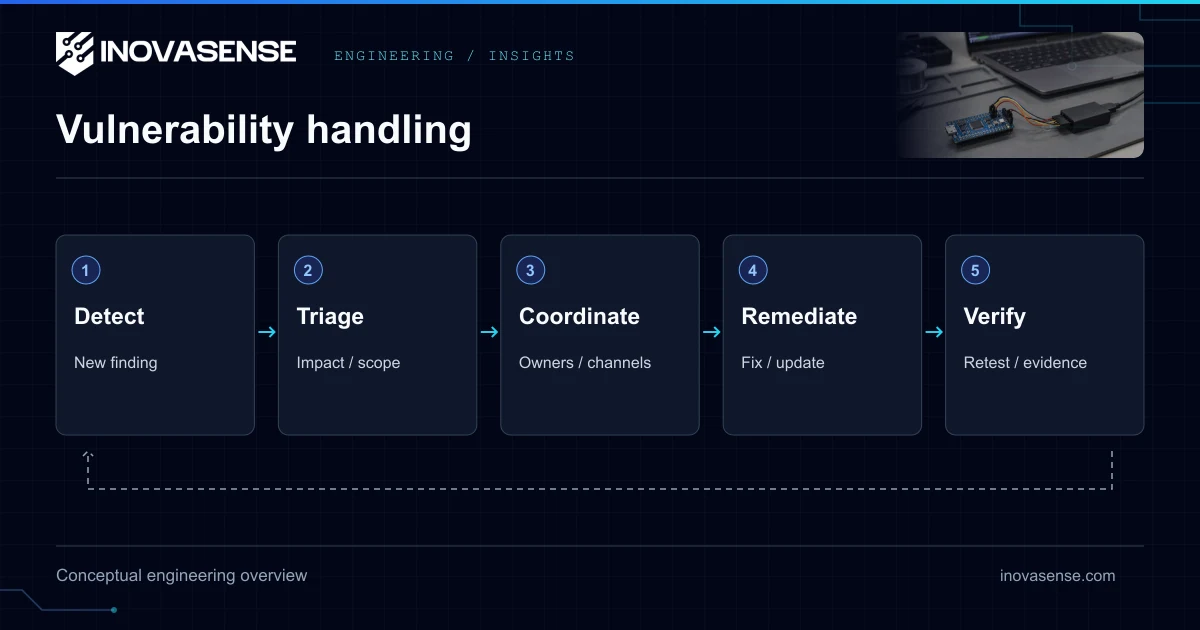
- Documented vulnerability handling policy (intake → triage → report → patch → user notification)
- Legal team briefed on Article 14 requirements and Article 64 penalties
- Internal tabletop exercise completed (simulated vulnerability report)
Technical Infrastructure
- Automated SBOM generation integrated into CI/CD pipeline
- Continuous vulnerability scanning against CVE/NVD/EUVD databases
- Threat intelligence feeds subscribed (CISA KEV, vendor PSIRTs)
- CSAF/VEX capability for machine-readable user advisories
- Asset inventory of all products with digital elements on the EU market
Regulatory Registration
- CSIRT coordinator identified based on main establishment (Art. 14(7))
- ENISA Single Reporting Platform account registered (when available)
- SRP notification end-point tested with dry run
- Authorized representative designated (if non-EU manufacturer)
Documentation
- Vulnerability disclosure policy published on company website
- Contact information for security researchers clearly visible
- Template for each report stage prepared (early warning, notification, final report)
- Archive system for past SBOMs and vulnerability records
Don’t Wait for September to Find Out You’re Not Ready
The 24-hour early warning deadline is unforgiving. There is no grace period, no “soft launch.” On September 11, 2026, Article 14 applies in its entirety.
Most hardware companies underestimate what it takes to detect an actively exploited vulnerability within 24 hours. Without continuous SBOM-based monitoring, automated CVE correlation, and a pre-established reporting workflow, you will miss the deadline — and face fines up to €15 million.
Need help building CRA-compliant vulnerability management into your hardware product? Our Embedded Security & IoT team architects complete vulnerability management systems — from SBOM generation at build time to automated CVE monitoring and incident response procedures.
September 11, 2026 is 134 days away. Is your reporting infrastructure ready?
Sources and Verification
All regulatory claims in this article have been verified against the official text of Regulation (EU) 2024/2847 as published in the Official Journal of the European Union (OJ L, 2024/2847, 20.11.2024). Specific articles referenced: Art. 14 (reporting obligations), Art. 16 (single reporting platform), Art. 64 (penalties), Art. 71 (entry into force and application). ENISA role verified via ENISA Vulnerability Disclosure page.
Disclaimer: This article provides general information based on the published regulation text and is not legal advice. For binding interpretations, consult the official regulation or qualified legal counsel. Regulatory details may change through implementing acts and delegated acts adopted by the European Commission.