
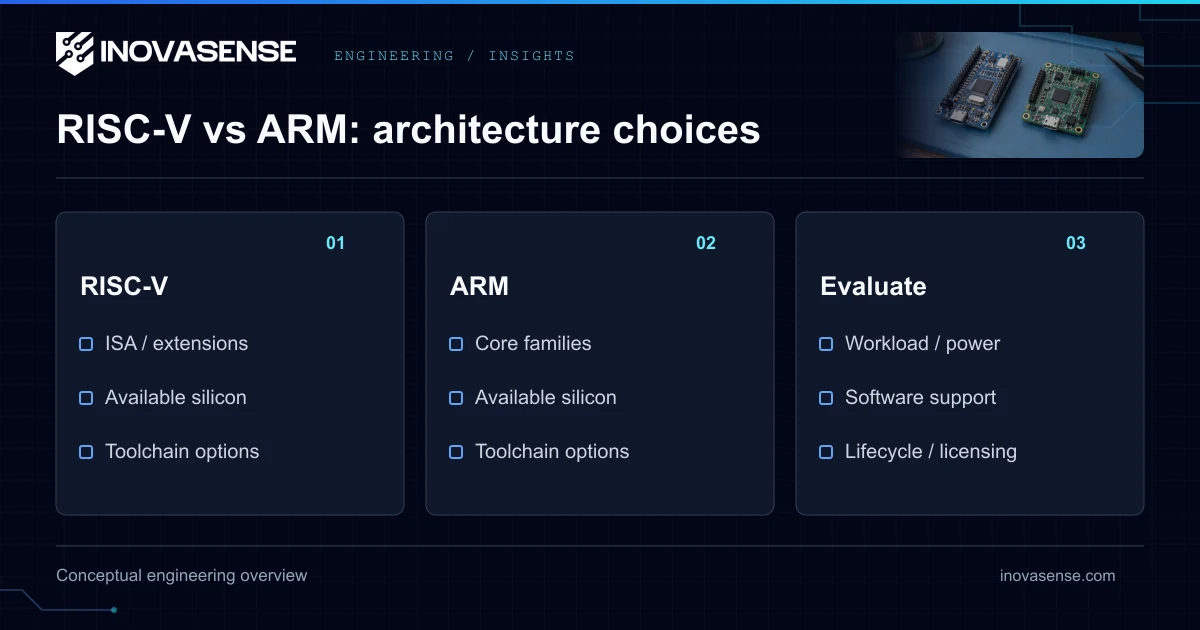
What is the difference between RISC-V and ARM?
ARM is a proprietary processor architecture licensed by Arm Holdings, powering 99% of smartphones and the majority of embedded systems. RISC-V is an open-source instruction set architecture (ISA) with no licensing fees, allowing anyone to design, modify, and manufacture RISC-V processors. ARM offers a mature ecosystem with proven silicon and extensive software support. RISC-V offers zero licensing costs, full architectural customization, and no vendor lock-in. For embedded projects requiring custom processor integration, see our FPGA Design Services — where RISC-V soft cores are increasingly deployed.
Why This Decision Matters Now
The processor architecture you choose for an embedded product locks you in for 5–15 years of product lifecycle. In 2026, this decision is more consequential than ever because:
-
RISC-V has reached production maturity. Over 10 billion RISC-V cores have shipped as of 2025. It’s no longer experimental — SiFive, Espressif (ESP32-C3/C6), Bouffalo Lab, and WCH are shipping production silicon.
-
ARM licensing costs are increasing. Arm Holdings’ IPO and subsequent business strategy have pushed licensing fees higher, particularly for IoT-scale designs where margins are thin.
-
EU digital sovereignty demands open architectures. The EU Chips Act’s €43 billion investment explicitly supports open-source hardware, and the European Processor Initiative (EPI) is building its HPC processors on RISC-V.
-
AI at the edge requires custom instructions. RISC-V’s extensible ISA lets you add custom AI acceleration instructions — ARM’s fixed ISA cannot match this flexibility. See Edge AI.
Choosing wrong means either overpaying for ARM licenses on a cost-sensitive IoT device, or underestimating the tooling maturity needed for a time-critical launch.
Architecture Fundamentals
What Makes Them Similar
Both ARM and RISC-V are RISC (Reduced Instruction Set Computer) architectures:
- Load/store architecture — memory access separated from computation
- Fixed-width instructions (mostly 32-bit)
- Large register files (32 general-purpose registers in both)
- Pipelined execution for high throughput
What Makes Them Different
| Aspect | ARM | RISC-V |
|---|---|---|
| License model | Proprietary — pay per core or per chip | Open-source (BSD) — free forever |
| ISA extensions | Fixed by Arm Holdings (Neon, SVE, Helium) | Modular — add custom extensions freely |
| Instruction encoding | Variable (Thumb-2: 16/32-bit) | Clean fixed-width (32-bit base, 16-bit compressed) |
| Architecture versions | ARMv7-M, ARMv8-M, ARMv9 (complex versioning) | Simple: RV32I, RV64I + standard extensions (M, A, F, D, C) |
| Backward compatibility | Extensive (decades of legacy support) | Clean-slate design, no legacy burden |
| Custom instructions | Not permitted by license | Fully permitted and encouraged |
| Vendor lock-in | Tied to Arm Holdings’ roadmap and pricing | No single vendor dependency |
RISC-V’s Modular ISA Explained
RISC-V’s key innovation is its modular design. You pick only the extensions you need:
RV32I     — Base integer (mandatory, 47 instructions)
  + M    — Integer multiply/divide
  + A    — Atomic operations (multi-core, RTOS)
  + F    — Single-precision floating point
  + D    — Double-precision floating point
  + C    — Compressed instructions (16-bit, reduces code size 25-30%)
  + V    — Vector operations (SIMD, AI acceleration)
  + B    — Bit manipulation
  + Zicsr — Control/status registers
  + Custom — YOUR custom instructions for your application
Example: A simple IoT sensor needs only RV32IMC (integer + multiply + compressed) — a tiny core using ~15K gates. A Linux-capable application processor needs RV64IMAFDC — a much larger core but still license-free.
This modularity is why RISC-V is particularly powerful when integrated into FPGAs — you can synthesize exactly the processor you need alongside custom hardware accelerators.
Head-to-Head Performance Comparison
Real Silicon Benchmarks (2026 Data)
| Chip | Architecture | Core | MHz | CoreMark | CoreMark/MHz | Power | Price (1K qty) |
|---|---|---|---|---|---|---|---|
| STM32F407 | ARM Cortex-M4 | M4 | 168 | 566 | 3.37 | 150 mW | €6.50 |
| GD32VF103 | RISC-V (Bumblebee) | RV32IMAC | 108 | 360 | 3.33 | 90 mW | €2.80 |
| ESP32-C3 | RISC-V | RV32IMC | 160 | 407 | 2.55 | 110 mW | €1.20 |
| ESP32-S3 | ARM+Xtensa | Dual Xtensa LX7 | 240 | 1,181 | 4.92 | 310 mW | €2.50 |
| STM32U5 | ARM Cortex-M33 | M33+TrustZone | 160 | 651 | 4.07 | 40 mW | €5.80 |
| BL616 | RISC-V (T-Head E907) | RV32IMAFCP | 320 | 1,050 | 3.28 | 120 mW | €1.50 |
| CH32V307 | RISC-V (RISC-V4F) | RV32IMAFCX | 144 | 476 | 3.31 | 80 mW | €1.80 |
| SiFive U74 | RISC-V | RV64GC | 1,500 | 8,200 | 5.47 | 2 W | €15+ (SoM) |
| NXP i.MX 8M | ARM Cortex-A53 | A53 quad | 1,800 | 12,600 | 7.00 | 3 W | €18+ |
Key takeaways:
- At the MCU level (Cortex-M vs RV32), performance per MHz is comparable — within 10–20%
- ARM application processors (Cortex-A) still lead in absolute raw performance
- RISC-V chips are consistently 30–60% cheaper at equivalent performance tiers
- RISC-V power efficiency is competitive, with some chips leading in performance-per-watt
Where ARM Wins on Performance
- High-performance application processors — Cortex-A78, A720, X4 are years ahead of RISC-V application cores
- GPU-integrated SoCs — ARM Mali and Immortalis GPUs have no RISC-V equivalent
- AI acceleration — ARM Ethos NPU is production-proven; RISC-V vector extension AI is emerging
Where RISC-V Wins on Performance
- Ultra-low-power MCUs — smaller cores, lower quiescent current
- Custom-accelerated workloads — custom ISA extensions can outperform ARM by 10–100× for specific algorithms
- FPGA soft cores — RISC-V cores synthesize efficiently on FPGAs; ARM has no equivalent FPGA licensing
Ecosystem Maturity: The Real Differentiator
Performance is close. The ecosystem gap is where the real differences live:
Development Tools
| Tool Category | ARM | RISC-V |
|---|---|---|
| IDE | Keil MDK, IAR, STM32CubeIDE (mature, integrated) | PlatformIO, Freedom Studio, Eclipse-based (functional, less polished) |
| Compiler | ARM GCC, ARM Compiler 6, IAR (highly optimized) | GCC (good), LLVM/Clang (improving fast) |
| Debugger | J-Link, ST-Link, ULINK (hardware + software mature) | J-Link (partial), OpenOCD (good), custom probes |
| RTOS | FreeRTOS, Zephyr, Mbed OS, ThreadX (first-class support) | FreeRTOS, Zephyr, RT-Thread (good support, growing) |
| Linux | Mature, millions of deployments | Functional, mainline kernel support since 2022 |
| Documentation | Extensive, professional-grade | Variable — excellent for major vendors, sparse for smaller ones |
Software Library Availability
| Library/Framework | ARM Support | RISC-V Support |
|---|---|---|
| TensorFlow Lite Micro | ✅ Optimized (CMSIS-NN) | ⚠️ Functional, not optimized |
| mbedTLS / WolfSSL | ✅ Hardware-accelerated | ⚠️ Software-only on most chips |
| CMSIS-DSP | ✅ ARM-specific optimization | ❌ No equivalent (use custom) |
| Bluetooth stack (NimBLE) | ✅ Mature | ✅ Good (ESP32-C3/C6) |
| Wi-Fi stack | ✅ Mature | ✅ Good (ESP32-C series) |
| USB stack (TinyUSB) | ✅ Mature | ✅ Growing |
| Motor control (FOC) | ✅ ST, TI optimized libs | ⚠️ Limited, mostly custom |
Bottom line: ARM’s ecosystem is 15+ years more mature. If your project needs a specific peripheral library, RTOS integration, or optimized DSP routine, check RISC-V support before committing to it.
Licensing and Cost Analysis
ARM Licensing Structure
ARM licensing operates in tiers:
| License Type | Cost | What You Get |
|---|---|---|
| Per-chip royalty | 1–2% of chip price | Use pre-designed ARM core (e.g., Cortex-M4) |
| Architecture license | $1M–$10M+ upfront + royalties | Design your own ARM-compatible core |
| Flexible Access | $200K–$1M/year subscription | Access to full portfolio during development |
RISC-V Cost Structure
| Component | Cost |
|---|---|
| ISA license | $0 — open-source (BSD license) |
| Soft core IP | $0 (open-source: VexRiscv, PicoRV32, NEORV32) to $50K–$500K (commercial: SiFive, Andes) |
| Development tools | $0 (GCC, OpenOCD) to $5K–$20K (commercial IDEs) |
| RISC-V International membership | $0 (community) to $250K/year (strategic member) |
Cost Impact at Scale
| Production Volume | ARM Royalty Burden | RISC-V Savings |
|---|---|---|
| 10,000 units | ~€2,000–€20,000 | Negligible benefit |
| 100,000 units | ~€20,000–€200,000 | Meaningful savings |
| 1,000,000 units | ~€200,000–€2,000,000 | Significant — can fund custom development |
| 10,000,000 units | ~€2M–€20M | Massive — this is why RISC-V adoption accelerates at scale |
Key insight: For low-volume IoT products (<50K units), the cost difference is negligible — choose based on ecosystem. For high-volume consumer IoT (>500K units), RISC-V licensing savings become a strategic advantage.
RISC-V on FPGA: The Unique Advantage
One area where RISC-V has no ARM equivalent is FPGA deployment. ARM does not license its cores for FPGA synthesis (with rare exceptions). RISC-V soft cores are freely synthesizable:
Popular RISC-V FPGA Cores
| Core | Language | Architecture | Size (LUTs) | MHz (Artix-7) | Features |
|---|---|---|---|---|---|
| PicoRV32 | Verilog | RV32IMC | ~1,500 | 250–400 | Ultra-small, ideal for control |
| VexRiscv | SpinalHDL | RV32IMAFDC | 1,500–4,000 | 200–300 | Highly configurable, pipeline options |
| NEORV32 | VHDL | RV32IMACB_Zicsr | 3,000–5,000 | 100–200 | Full SoC with peripherals, excellent docs |
| CVA6 (Ariane) | SystemVerilog | RV64IMAFDC | 30,000+ | 100–150 | Linux-capable, application-class |
| Ibex | SystemVerilog | RV32IMC | 3,000–4,000 | 200+ | lowRISC/Google, security-focused |
Why this matters: You can put a RISC-V processor inside your FPGA alongside custom hardware accelerators — running firmware for configuration and control while the FPGA fabric handles real-time signal processing. This is the architecture behind modern Edge AI platforms and software-defined instruments.
At Inovasense, we regularly deploy RISC-V soft cores in our FPGA designs for control plane processing, protocol management, and configuration — eliminating the need for a separate MCU on the board.
EU Sovereignty and Strategic Considerations
The European Angle
The EU has made open architectures a strategic priority:
- European Processor Initiative (EPI) — building RISC-V-based HPC and automotive processors with €240M+ EU funding
- EU Chips Act — €43 billion investment explicitly supports open-source hardware and designs that reduce dependency on non-EU IP vendors
- DARE project — EU-funded RISC-V for space applications
- OpenHW Group (based in Europe) — collaborative RISC-V core development (CORE-V family)
For European hardware companies, RISC-V offers a path to architectural independence — no dependency on a single British/Japanese IP vendor (Arm Holdings, owned by SoftBank) for the core of your product.
Export Control Implications
Under EU dual-use regulations, the processor architecture itself generally isn’t controlled — but custom extensions for cryptography or signal processing may require export licensing. RISC-V’s transparency (open-source, auditable) can actually simplify security certification processes compared to ARM’s closed IP.
Supply Chain Diversification
ARM chips come from a limited set of vendors (ST, NXP, TI, Nordic, etc.). RISC-V silicon is available from a broader, more diverse supply chain:
- China — Espressif, Bouffalo Lab, WCH, Allwinner (cost-optimized IoT)
- Europe — Codasip, Andes (via TSMC EU), GreenWaves (AI-focused)
- US/Global — SiFive, Microchip (PolarFire SoC), Qualcomm (exploring RISC-V)
This diversity reduces single-vendor risk — a lesson many companies learned during the 2021–2023 chip shortage.
Decision Framework: When to Choose Which
Choose ARM When:
✅ Time-to-market is critical — ARM’s mature ecosystem means less debugging, more existing code, faster development ✅ You need proven, optimized libraries — DSP, ML inference, motor control with vendor-optimized code ✅ You’re building on an existing ARM codebase — porting from Cortex-M to Cortex-M is trivial; porting to RISC-V takes effort ✅ You need TrustZone security — ARM’s TrustZone is mature and certified (PSA Level 2+) ✅ High-performance application processor — Cortex-A series still leads RISC-V by 2–3 years ✅ Your team has ARM expertise — retraining costs are real
Choose RISC-V When:
✅ Cost per unit is critical — zero royalties compound at high volumes ✅ You need custom instructions — AI acceleration, custom crypto, domain-specific processing ✅ You’re deploying on FPGA — RISC-V soft cores are free, ARM is not available ✅ EU sovereignty matters — open-source ISA with no vendor dependency ✅ Ultra-low-power design — strip the ISA to bare minimum, eliminate unused logic ✅ You’re building a silicon product — SoC designers save millions in licensing ✅ Long product lifecycle (10+ years) — no risk of ISA vendor changing terms or increasing fees
The Hybrid Approach
Many sophisticated designs use both:
- RISC-V for the real-time control plane (small, deterministic, license-free)
- ARM for the application plane (Linux, GUI, networking, AI inference)
- FPGA for hardware acceleration (signal processing, custom interfaces)
This heterogeneous approach is increasingly common in industrial products and automotive systems.
Security Comparison
| Security Feature | ARM | RISC-V |
|---|---|---|
| Trusted execution | TrustZone (mature, certified) | PMP + sPMP (functional, less mature) |
| Secure boot | Proven implementations | Available, vendor-dependent |
| Side-channel resistance | Extensive research, mitigations | Growing research, some gaps |
| Formal verification | Limited (closed source) | Possible (open source enables full audit) |
| Post-quantum readiness | Vendor-dependent | Custom extensions possible |
| CRA compliance | Straightforward with TrustZone | Achievable with careful design |
Key insight for security-critical applications: ARM’s security story is more mature today. But RISC-V’s openness enables deeper security auditing — you can verify every transistor, which is impossible with ARM’s closed IP. For defense and critical infrastructure, this transparency is increasingly valued.
Getting Started with RISC-V
If you’re evaluating RISC-V for a new project:
Quick Start Hardware
| Board | Chip | Price | Best For |
|---|---|---|---|
| ESP32-C3-DevKitM | ESP32-C3 (RV32IMC) | €8 | Wi-Fi/BLE IoT, Arduino-compatible |
| Milk-V Duo | CV1800B (RV64GCV + ARM A53) | €9 | Linux + RTOS, dual-architecture |
| Sipeed Longan Nano | GD32VF103 (RV32IMAC) | €5 | Bare-metal embedded, STM32-like |
| SiFive HiFive Unmatched | SiFive U74 (RV64GC) | €600 | Desktop Linux, SW development |
| Digilent Arty A7 + VexRiscv | FPGA soft core | €130 | Custom RISC-V SoC prototyping |
Learning Path
- Start with ESP32-C3 — familiar Arduino/PlatformIO environment, Wi-Fi/BLE included
- Try bare-metal — write startup code, understand CSRs, configure timer interrupts
- Add an RTOS — port FreeRTOS or Zephyr to understand the HAL differences from ARM
- Go FPGA — synthesize VexRiscv or NEORV32 on an Arty board and customize the SoC
Frequently Asked Questions
Will RISC-V replace ARM?
Not in the short
Sources & Official References
- Cyber Resilience Act — Regulation (EU) 2024/2847 — EUR-Lex (Official Journal of the EU)
- EU Dual-Use Regulation — Regulation (EU) 2021/821 — EUR-Lex (Official Journal of the EU)
Related guides inEmbedded Systems Development
Explore all →Embedded Programming: Engineer's Guide
Embedded programming guide — bare-metal C on Cortex-M, RTOS design, JTAG debugging, and TinyML. Updated for 2026 with Rust and RISC-V.
ESP32 vs STM32: Which MCU for Your Next Product?
Compare specific ESP32 and STM32 devices: connectivity, CPU architecture, battery measurements, security, software support and total product cost.
IoT Explained: Technical Deep-Dive
IoT connects devices via sensors, MCUs, and wireless protocols for real-time data. How it works — from silicon to cloud in 2026.