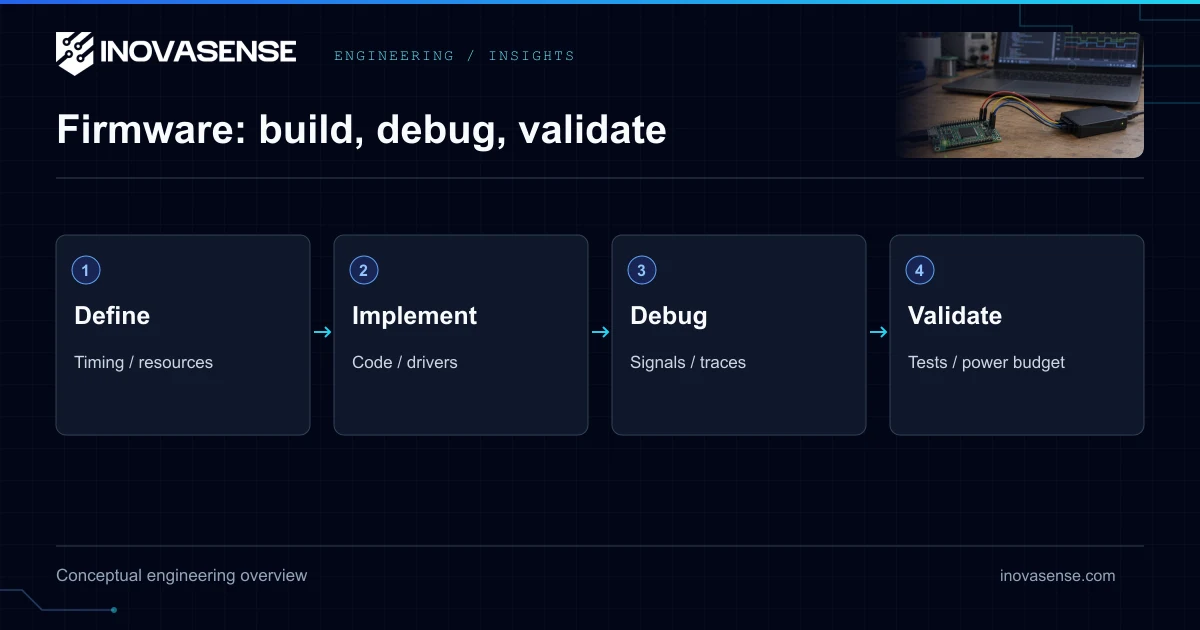
What is Embedded Programming?
Embedded programming is the specialized practice of writing low-level software that runs directly on microcontrollers (MCUs) or FPGAs to control hardware without a general-purpose operating system. It requires deep knowledge of registers, memory management, and hardware security to ensure real-time performance. The dominant languages are C and C++, with Rust gaining rapid adoption for safety-critical applications.
Here’s a scenario that every embedded engineer has lived through at least once:
It’s 2 AM. Your firmware has been running flawlessly in the lab for 72 hours. You deploy ten units to the field. Within 48 hours, three devices are locked up — no crash dump, no error log, no way to reproduce it on the bench. Your logic analyzer shows clean signals. Your debugger can’t attach without resetting the chip. And your customer’s deadline is Monday.
Welcome to embedded programming — where the bugs don’t care about your unit tests, the hardware fights back, and “it works on my bench” is the most dangerous sentence in engineering.
This guide is not another textbook introduction. It’s a field manual built from practical work on embedded products — from battery-powered sensors to devices that must respond within microseconds. Whether you’re writing your first main() on an Arduino or architecting a multi-core Cortex-A system with Yocto Linux, this guide will make you a better embedded engineer.
What Makes Embedded Programming Different
Embedded programming isn’t just “programming but smaller.” It’s a fundamentally different discipline with its own physics:
💻 Application Programming
- Infinite RAM (virtual memory)
- OS handles scheduling, I/O, memory
- Crash? Restart the process
- Debug with breakpoints and logs
- Deploy via app stores or Docker
- Performance measured in "fast enough"
🔧 Embedded Programming
- 64 KB RAM (or less) — every byte matters
- You ARE the OS — you write the scheduler
- Crash? Device is bricked in a field 200 km away
- Debug with oscilloscopes and JTAG probes
- Deploy via JTAG flash or signed OTA updates
- Performance measured in microseconds
The most fundamental difference? Timing is not optional. When your motor control loop misses its 50 µs deadline, the motor doesn’t politely wait — it judders, overheats, or stalls. When your airbag controller takes 1 ms too long to fire, someone gets hurt. Embedded programming is where software meets physics, and physics always wins.
Choosing Your Processor: The Decision That Shapes Everything
The first decision in any embedded project determines every decision that follows. Choose wrong, and you’ll spend months fighting a platform instead of building a product:
| Platform | Example | Clock | RAM | When to Choose |
|---|---|---|---|---|
| 8-bit MCU | ATmega328P, PIC18 | 16–20 MHz | 2–8 KB | Simple sensors, legacy products, extreme cost pressure (<€0.30/unit) |
| 32-bit MCU | STM32F4 (Cortex-M4) | 168 MHz | 192 KB | The workhorse — motor control, industrial I/O, BLE devices |
| High-perf MCU | STM32H7 (Cortex-M7) | 480 MHz | 1 MB | DSP, TinyML inference, real-time audio/video processing |
| Application Processor | i.MX 8M (Cortex-A53) | 1.8 GHz | External DDR | Linux-based systems, multi-camera, GUI, networking stacks |
| FPGA SoC | Zynq-7000 (A9 + fabric) | 866 MHz + FPGA | External DDR | Custom datapath + software — when MCUs aren’t fast enough |
A typical mistake: An application processor such as the i.MX 8M is chosen for what is essentially a sensor node that reads an ADC and transmits one value per second. The BOM then costs tens of euros where a few euros would do, the device boots in seconds instead of milliseconds, and it draws watts where the battery budget allows tens of microamps. Choosing the right platform isn't an optimization — it's a survival decision.
The Real Decision: Bare-Metal, RTOS, or Linux?
-
Bare-metal (no OS) — For applications with <5 concurrent tasks and hard real-time requirements. You write the main loop, the interrupt handlers, and the state machines. Total control, total responsibility. Best for: battery-powered sensors, simple actuators, timing-critical signal processing.
-
RTOS (FreeRTOS, Zephyr, ThreadX) — When you need more than one task running concurrently with predictable priorities. The RTOS handles preemptive scheduling, inter-task communication (queues, semaphores), and timer management. Best for: most IoT devices, industrial controllers, communication stacks.
-
Embedded Linux (Yocto, Buildroot) — When you need networking stacks (TCP/IP, Wi-Fi), filesystem management, display/GUI, or need to run third-party libraries. Gives up hard real-time guarantees but gains an enormous ecosystem. Best for: gateways, HMI panels, edge computing, multi-camera systems.
Languages: Why C Still Rules (and Why Rust is Coming for the Crown)
The embedded world runs on C. Not because it’s trendy — because it maps directly to what the hardware actually does:
// This is not abstraction — this IS the hardware
// Setting bit 5 of GPIOA output register = putting 3.3V on physical pin PA5
GPIOA->ODR |= (1 << 5);    // LED turns on. Right now. Within a few clock cycles.
Every line of C compiles to a predictable sequence of machine instructions. There’s no garbage collector pausing your motor control loop. No virtual method dispatch adding 200 ns of latency to your interrupt handler. No hidden allocations fragmenting your 64 KB of RAM.
C dominates embedded projects because:
- Direct hardware access — Pointers, bitwise operations,
volatilequalifiers for register manipulation - Deterministic memory — No garbage collector; you allocate, you free, you know exactly what’s happening
- Zero runtime overhead — Compiled code runs directly on the CPU, no VM or interpreter
- Toolchain maturity — GCC, IAR, Keil MDK have decades of optimization for ARM; GCC and IAR also cover AVR and RISC-V
C++ adds object-oriented abstractions, templates, and RAII patterns for resource management — particularly valuable for larger codebases where C’s lack of namespaces and type safety become liabilities.
The Rust Revolution
Rust is the most significant language shift in embedded programming in 30 years. It delivers C-level performance with compile-time memory safety — no null pointer dereferences, no buffer overflows, no data races. In safety-critical and security-sensitive applications, this isn’t just convenient; it’s potentially transformative.
// Rust embedded — type-safe, zero-cost abstraction, compile-time ownership checking
#[entry]
fn main() -> ! {
    let dp = pac::Peripherals::take().unwrap();  // Singleton — can't accidentally access twice
    let gpioa = dp.GPIOA.split();
    let mut led = gpioa.pa5.into_push_pull_output();

    loop {
        led.set_high();     // Type system guarantees this is a valid output pin
        delay_ms(500);
        led.set_low();
        delay_ms(500);
    }
}
The embedded-hal ecosystem provides hardware abstraction layers for major MCU families. In 2026, Rust embedded is production-ready for new projects — Ferrocene (the safety-certified Rust compiler) is qualified for ISO 26262 (ASIL D) and IEC 61508 (SIL 3; the vendor supports customer certification toward SIL 4).
Our take: We use C for projects porting existing codebases or targeting MCUs with limited Rust toolchain support. For new projects — especially anything security-critical or CRA-regulated — we evaluate Rust first. The compile-time safety guarantees eliminate entire categories of field failures that are costly to debug and patch on deployed hardware.
RTOS: The Heartbeat of Embedded Systems
An RTOS isn’t just “a small operating system.” It’s a contract about time: the guarantee that your highest-priority task will execute within a bounded number of microseconds, no matter what else is happening.
Why You Need an RTOS (and When You Don’t)
Consider a sensor node that must simultaneously:
- Read an accelerometer at exactly 1 kHz (every 1,000 µs)
- Process BLE packets when they arrive (unpredictable timing)
- Log data to flash when the buffer fills (every ~10 seconds)
- Go to deep sleep between events to preserve battery
In bare-metal, you’d juggle this with interrupt priorities, flags, and a state machine in while(1). It works for 3 tasks. At 6 tasks, it becomes an unreadable mess. At 10 tasks, it’s unmaintainable.
An RTOS makes this clean:
// FreeRTOS — each concern is its own task with explicit priority
void vAccelerometerTask(void *p)  { /* Priority 3 — highest, hard real-time */ }
void vBLETask(void *p)            { /* Priority 2 — responsive to radio events */ }
void vLoggingTask(void *p)        { /* Priority 1 — runs when nothing else needs CPU */ }
void vIdleHook(void)              { /* Priority 0 — enters STOP2 mode, 2 µA */ }
RTOS Selection Guide
| RTOS | License | Best For | Safety Certifications |
|---|---|---|---|
| FreeRTOS | MIT | Most IoT devices. Enormous community, AWS integration | SAFERTOS variant: IEC 61508 SIL 3 |
| Zephyr | Apache 2.0 | Nordic BLE, Intel, multi-protocol devices | IEC 61508 path in progress |
| Eclipse ThreadX (formerly Azure RTOS) | MIT (since 2024) | High-reliability, medical, automotive | IEC 61508 SIL 4; also IEC 62304, ISO 26262, EN 50128 (SGS-TÜV Saar) |
| VxWorks | Commercial | Aerospace, defense, medical Class III | DO-178C DAL A, IEC 61508 SIL 3, ISO 26262 ASIL D, IEC 62304 Class C |
| RTEMS | BSD | Space, scientific instruments | None; pre-qualification effort only, qualification is done per project on the target hardware |
RTOS trap #1: Priority inversion. Your high-priority task blocks on a mutex held by a low-priority task. A medium-priority task preempts the low-priority task. Result: your highest-priority task is starved indefinitely by a medium-priority task that has nothing to do with it. This caused repeated computer resets on the Mars Pathfinder lander in 1997. Solution: always enable priority inheritance on mutexes. FreeRTOS has it. Use it.
RTOS trap #2: Stack overflow in tasks. Each RTOS task has its own stack of a fixed size, set when the task is created. If your task's stack is 512 bytes and you declare a 256-byte local array, one nested function call and you're writing into another task's memory. The crash is non-deterministic and appears as random data corruption. Solution: use uxTaskGetStackHighWaterMark() during development to measure actual stack usage, then add 25% margin.
Debugging: Where Embedded Engineers Earn Their Scars
Embedded debugging is the hardest kind of debugging because the bug and the observation tool share the same hardware. Attaching a debugger changes timing. Adding printf statements changes memory layout. Turning on a LED changes power consumption. You are debugging a quantum system where observation disturbs the state.
The Essential Toolkit
🔌 JTAG/SWD Debugger
Segger J-Link, ST-Link, CMSIS-DAP. Step through code, set breakpoints, inspect registers on the live target. SWD is the 2-wire variant found on almost all ARM Cortex-M devices.
📊 Logic Analyzer
Saleae Logic Pro 16. Capture and decode SPI, I²C, UART, CAN, 1-Wire at the electrical level. Indispensable for verifying that your software is actually producing the right bus traffic.
🔋 Power Profiler
Nordic PPK2, Otii Arc. Measure µA-resolution current consumption over time. Essential for battery life optimization — one forgotten peripheral left on in sleep mode can cut battery life from 3 years to 3 weeks.
📡 Oscilloscope
Rigol DS1054Z (budget) or Keysight MSOX. Measure timing, signal integrity, rise/fall times, and analog waveforms. Critical for understanding why your SPI bus works at 1 MHz but fails at 10 MHz.
The Five Hardest Embedded Bugs
These are the bugs that separate junior from senior embedded engineers:
1. The Heisenbug — A timing-dependent bug that disappears when you attach a debugger. The debugger changes execution timing by inserting breakpoints, which pauses the CPU. This eliminates the exact race condition you’re trying to observe. Solution: use GPIO toggle pins and an oscilloscope for non-intrusive timing observation.
2. The DMA conflict — Two peripherals configured to use the same DMA channel or memory region. Works fine when only one is active. Corrupts data unpredictably when both fire simultaneously. Only appears under specific load conditions that are nearly impossible to reproduce in the lab.
3. Stack corruption — A buffer overflow on one task’s stack overwrites another task’s data. The corrupted task doesn’t crash immediately — it runs with wrong values until something catastrophic happens minutes or hours later. The crash dump points to the victim, not the perpetrator.
4. Clock domain crossing — In FPGA/mixed-signal designs, data transferred between different clock domains without proper synchronization. Causes metastability — a logic level that is neither 0 nor 1, yielding different results on each read. Manifests as seemingly random one-bit errors.
5. The 49.7-day overflow — A 32-bit millisecond counter overflows after 2³² ms ≈ 49.7 days. The device runs perfectly in the lab for your 72-hour test. Deploys to the field. The counter wraps exactly 49.7 days after power-up, every single time — and code that compares timestamps the wrong way fails at that moment.
A typical overflow bug: Imagine 500 environmental sensors deployed in a smart building. After about 50 days, devices start freezing — not all of them, and not on the same day, because they were switched on at different times. The cause takes weeks to find: a uint32_t millisecond timer overflows after 49.7 days, and a comparison written as if (now > lastEvent + timeout) works for 49 days and then fails at the wrap: if the deadline falls just before the overflow boundary and the device is busy transmitting as it passes, now wraps to zero and the timeout never fires. The fix is one line — if (now - lastEvent > timeout), which unsigned arithmetic keeps correct across the wrap — but finding it costs weeks of debugging and an OTA update for every device.
Power Optimization: Making Batteries Last Years
For battery-powered IoT devices, power optimization isn’t a nice-to-have — it’s the entire product. The difference between a coin cell lasting 3 months and 5 years is entirely in the firmware:
The Power Budget Mindset
Active mode (sensor read + TX):  15 mA × 200 ms  = 3.0 mA·s
Sleep mode:                      2.5 µA × 59.8 s = 0.15 mA·s
                                 ─────────────────────────────
Average current per 60s cycle:   3.15 / 60        = 52.5 µA

CR2032 capacity: 225 mAh
Estimated life: 225,000 / 52.5  = 4,286 hours ≈ 178 days

// But if you forget to disable the ADC before sleep:
Sleep mode with ADC on:          150 µA × 59.8 s  = 8.97 mA·s
New average:                     11.97 / 60        = 199.5 µA
New battery life:                225,000 / 199.5   = 47 days ← DESTROYED
One peripheral left on in sleep mode cut battery life from 6 months to 47 days. This is why power profiling tools (Nordic PPK2, Otii Arc) are mandatory, not optional.
The Power Optimization Checklist
- Clock gating — Disable peripheral clocks when not in use. An idle SPI module still consumes power if clocked
- Sleep modes — Use the deepest sleep mode possible. STM32L476 STOP2 mode: 1.1 µA with SRAM retention (1.4 µA with RTC)
- ADC management — Start ADC → sample → stop ADC. Never leave it running continuously
- RF duty cycling — For radio devices, schedule transmissions and use the radio’s sleep mode between events
- Voltage scaling — Run the core at the lowest voltage that supports your required clock speed
- Wake sources — Use hardware interrupts (GPIO EXTI, RTC alarm) for wake-up, not periodic polling
The 2026 Landscape: Three Shifts Reshaping Embedded
🧠 TinyML Everywhere
ML inference is becoming a standard peripheral. MCUs like STM32N6 include dedicated NPUs (600 GOPS). Keyword detection, anomaly detection, and vibration analysis now run on €3 chips at 1 mW. AI is a hardware feature, not a cloud dependency.
🔐 Security-First by Law
The EU Cyber Resilience Act (EU 2024/2847) sets outcome-based security requirements — including integrity protection, secure updates and vulnerability handling — for products with digital elements sold in the EU. Infringements of the essential requirements and of Articles 13 and 14 can be fined up to €15 million or 2.5% of total worldwide annual turnover (Article 64). Security is no longer optional.
⚡ RISC-V Rising
Open-source ISA eliminates licensing costs and enables custom instruction extensions. Espressif ESP32-C3/C6 run RISC-V cores. Microchip PolarFire SoC combines RISC-V + FPGA. Silicon sovereignty without ARM licensing dependency.
Embedded Programming Patterns That Ship Products
These are the patterns that separate prototypes from products:
1. The Watchdog Pattern
// If your firmware hangs, the watchdog resets the chip automatically
// EVERY shipping product must have a watchdog. No exceptions.
IWDG->KR = 0xCCCC;  // Start watchdog
IWDG->KR = 0x5555;  // Unlock registers
IWDG->PR = 4;       // Prescaler: 64
IWDG->RLR = 2500;   // Timeout: ~5 seconds

// In your main loop or RTOS idle hook:
IWDG->KR = 0xAAAA;  // Feed the watchdog — "I'm still alive"
2. The State Machine
Every reliable embedded system is built around state machines. Not classes, not callbacks, not event buses — state machines. They’re testable, debuggable, and predictable:
typedef enum { STATE_INIT, STATE_IDLE, STATE_MEASURE, STATE_TRANSMIT, STATE_SLEEP, STATE_ERROR } State_t;

State_t state = STATE_INIT;

void app_run(void) {
    switch (state) {
        case STATE_INIT:     state = sensor_init()   ? STATE_IDLE : STATE_ERROR; break;
        case STATE_IDLE:     state = rtc_alarm_fired  ? STATE_MEASURE : STATE_IDLE; break;
        case STATE_MEASURE:  state = adc_read_all()   ? STATE_TRANSMIT : STATE_ERROR; break;
        case STATE_TRANSMIT: state = lora_send()      ? STATE_SLEEP : STATE_ERROR; break;
        case STATE_SLEEP:    enter_stop2(); state = STATE_IDLE; break;
        case STATE_ERROR:    error_count++; state = STATE_INIT; break;
    }
}
3. The Ring Buffer
The universal pattern for passing data between interrupt context and main context without dynamic allocation:
#define BUF_SIZE 256  // Must be power of 2
volatile uint8_t buf[BUF_SIZE];
volatile uint16_t head = 0, tail = 0;

// ISR context — runs in microseconds, never blocks
void USART1_IRQHandler(void) {
    buf[head & (BUF_SIZE - 1)] = USART1->RDR;
    head++;
}

// Main context — processes data at its own pace
void process_uart(void) {
    while (tail != head) {
        uint8_t byte = buf[tail & (BUF_SIZE - 1)];
        tail++;
        parse_command(byte);
    }
}
From Bench to Boardroom: Why Embedded Engineering Matters
Embedded systems now sit at the core of whole industries:
- Automotive — A modern vehicle can run 100+ ECUs with 100M+ lines of embedded code
- Medical devices — Class III implantables demand IEC 62304 life-cycle processes
- Industrial IoT — Smart factories run on embedded PLCs and edge controllers
- Edge AI — On-device inference eliminating cloud dependency for real-time decisions
The demand for embedded engineers far outpaces supply — making embedded programming one of the most valuable and defensible engineering skills in the industry.
How We Do Embedded at Inovasense
At Inovasense, we build our embedded work on these principles:
| Practice | What it means |
|---|---|
| MISRA C/C++ | Static analysis on every build — MISRA violations and undefined behavior are flagged before release |
| Hardware-in-the-loop CI | Automated tests run on real MCU targets, not just simulators |
| Signed OTA updates | Every firmware binary is signed; the bootloader verifies before flashing |
| Power profiling | Every sleep mode transition is measured — battery-life figures are validated by measurement, not taken from datasheets |
| CRA readiness | Secure boot, vulnerability management, and SBOM for EU market conformity |
From bare-metal firmware on Cortex-M0 to multi-threaded Linux applications on i.MX 8M — we design, build, test, and maintain embedded systems that work in the field, not just in the lab.
Need Embedded Engineering?
From MCU firmware to RTOS architecture to production-ready IoT devices — we ship embedded systems that survive the real world. EU-based. Built to CRA requirements. Battle-tested.
Discuss Your Project →Sources & Official References
- Cyber Resilience Act — Regulation (EU) 2024/2847 — EUR-Lex (Official Journal of the EU)
Frequently Asked Questions
What is an RTOS and how is it different from regular operating systems?
An RTOS (Real-Time Operating System) is a stripped-down operating system that guarantees task execution within strict timing deadlines — typically microseconds to milliseconds. Unlike Linux or Windows which optimize for throughput and user experience, an RTOS optimizes for deterministic latency. Common embedded RTOSes include FreeRTOS, Zephyr and Eclipse ThreadX (formerly Azure RTOS). RTOS runs on memory-constrained microcontrollers (Cortex-M, RISC-V) where Linux is too heavy.
Which RTOS should I choose for a new embedded project?
Choose FreeRTOS for general-purpose Cortex-M projects with minimal complexity — it has the largest community and is bundled with most vendor SDKs (STM32, ESP-IDF). Choose Zephyr for new projects needing modern networking, device tree configuration, and BLE/Thread support. Choose Eclipse ThreadX (formerly Azure RTOS) for projects needing a safety-certified kernel. Choose bare-metal (no RTOS) for ultra-simple firmware or hard real-time control loops with single deterministic task.
What is the difference between bare-metal and RTOS programming?
Bare-metal programming runs your code directly on the MCU without an OS layer — you manually manage hardware peripherals, interrupts, and a main loop. RTOS programming adds a task scheduler that lets multiple 'tasks' run concurrently with priority-based preemption. Bare-metal advantages: smaller memory footprint (~5–10 KB vs 15–50 KB RTOS), full timing control. RTOS advantages: cleaner code structure for multi-task systems, easier integration of communication stacks (TCP/IP, BLE).
Can I use Rust instead of C for embedded systems?
Yes — Rust is production-ready for embedded systems in 2026. Benefits: memory safety eliminates entire classes of vulnerabilities (buffer overflows, use-after-free); Microsoft has reported that about 70 % of the CVEs it assigns each year are memory-safety issues. Mature ecosystem includes embedded-hal abstraction, RTIC concurrency framework, and Embassy async runtime. Trade-offs: smaller talent pool than C, longer compile times, fewer pre-built drivers for some vendors. Mixed C+Rust projects are common — keep stable C drivers, write new features in Rust.
What is the latency of FreeRTOS on Cortex-M4?
Typical FreeRTOS task switching latency on a 168 MHz Cortex-M4 is 1.5–3 microseconds. Interrupt service routine (ISR) latency is 100–300 nanoseconds for ARM Cortex-M with vector tables in flash. Total worst-case response time from interrupt to highest-priority task running: typically under 10 microseconds. For sub-microsecond response requirements, use bare-metal interrupt handlers or move the critical path to FPGA fabric.
How much RAM does a minimal embedded RTOS need?
FreeRTOS minimum: 5–10 KB RAM, 5–10 KB flash for a basic kernel with 2–3 tasks and a few semaphores. Zephyr minimum: 8 KB RAM, 12 KB flash for similar functionality. For comparison: bare-metal main-loop firmware fits in 2–4 KB RAM. The 'RTOS overhead' is real but typically negligible on modern MCUs with 64+ KB RAM. Plan additional 2–5 KB per active task for stack.
Is JTAG required for embedded development?
Strongly recommended but not strictly required. JTAG (or its 2-wire variant SWD on ARM) provides hardware-level debugging: breakpoints, single-stepping, memory inspection, flash programming. Alternatives like UART-based bootloaders work for flashing but lack debugging capability. In production firmware, JTAG access is normally disabled or protected (RDP Level 2 on STM32, OTP fuses on ESP32). Limiting attack surfaces is one of the CRA essential requirements; the regulation does not prescribe how. Keep JTAG enabled during development; disable before shipping.
What's the future of embedded programming in 2026 and beyond?
Three shifts reshape embedded in 2026: (1) RISC-V adoption — Espressif ESP32-C series, SiFive cores, GD32VF103 series ship in production; Omdia forecasts almost a quarter of the processor market for RISC-V by 2030; (2) Rust mainstream adoption — Linux kernel accepted Rust drivers (2024), embedded Rust ecosystem matured; CRA compliance is easier with memory-safe languages; (3) AI at the edge — TinyML on Cortex-M with TensorFlow Lite Micro, FPGA-accelerated inference on SoC FPGAs.