
What is edge computing?
Edge computing is a distributed computing architecture that processes data at or near the source of data generation — on devices, gateways, or local servers — instead of sending everything to a centralized cloud data center. This reduces latency from seconds to milliseconds, conserves network bandwidth, improves privacy by keeping sensitive data local, and enables real-time decision-making in applications like autonomous vehicles, industrial automation, and Edge AI inference. Edge computing doesn't replace the cloud — it extends it to where the data lives.
Why Edge Computing Is No Longer Optional
The data explosion is real: by 2026, connected devices generate over 79 zettabytes of data annually. Sending all of it to the cloud is physically impossible, economically wasteful, and increasingly illegal under EU data residency regulations.
Three forces are making edge computing the default architecture:
1. Physics: The Speed of Light Is Too Slow
A round trip from a factory floor in Bratislava to an AWS data center in Frankfurt takes ~30 milliseconds at minimum. For a manufacturing robot that needs to react to a defect in under 1 millisecond, cloud processing is 30× too slow. Edge computing eliminates this latency by processing data locally.
2. Bandwidth: Networks Can’t Keep Up
A single autonomous vehicle generates ~20 TB of sensor data per day. A factory with 500 sensors produces ~1 TB per day. Uploading this to the cloud would require dedicated multi-gigabit connections and cost thousands in monthly cloud processing fees. Edge computing processes data locally and sends only actionable insights to the cloud — reducing bandwidth requirements by 90–99%.
3. Regulation: Data Can’t Always Leave
The EU’s GDPR requires that personal data be processed with legal basis and often within EU borders. The upcoming EU Data Act (effective September 2025) gives users the right to access and port data generated by IoT devices. Edge computing enables compliance by keeping sensitive data on-premises while still benefiting from cloud analytics on anonymized, aggregated data.
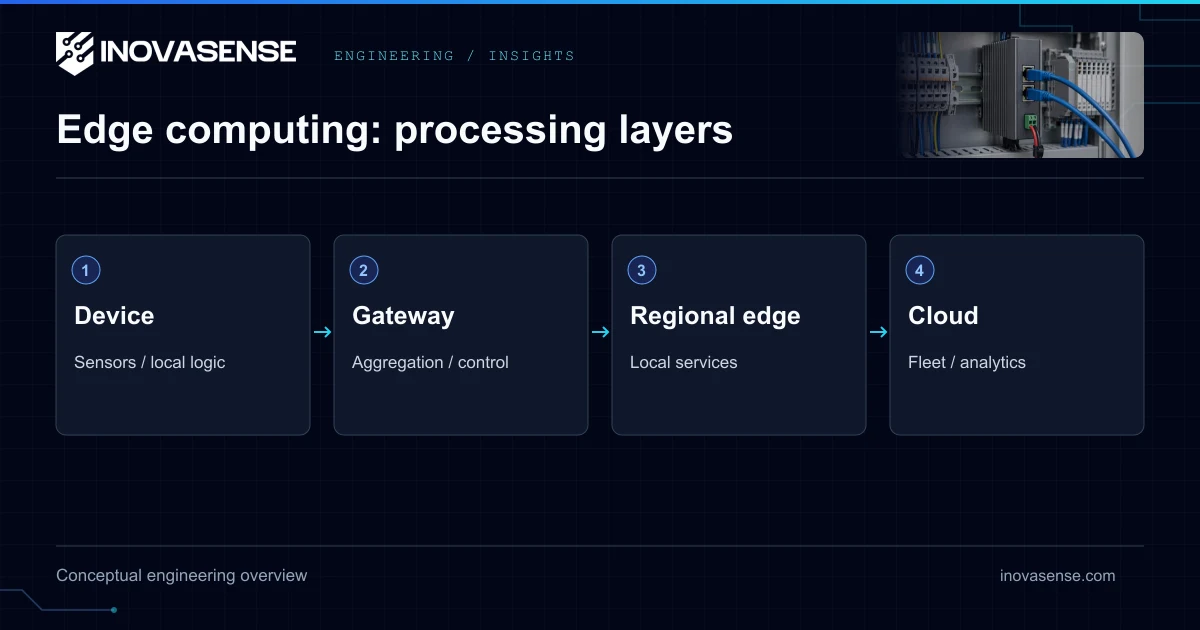
Edge Computing Architecture: The Four Layers
Edge computing isn’t a single device — it’s a hierarchical architecture with distinct processing layers:
┌──────────────────────────────────────────────┐
│                   CLOUD                       │
│  Long-term storage, model training,           │
│  global analytics, fleet management           │
│  Latency: 50–200ms                            │
├──────────────────────────────────────────────┤
│              REGIONAL EDGE                    │
│  On-premises servers, edge data centers       │
│  Complex inference, local dashboards          │
│  Latency: 5–20ms                              │
├──────────────────────────────────────────────┤
│              GATEWAY EDGE                     │
│  Industrial gateways, edge routers            │
│  Protocol translation, data aggregation       │
│  Latency: 1–5ms                               │
├──────────────────────────────────────────────┤
│              DEVICE EDGE                      │
│  Sensors, cameras, MCUs, FPGAs, NPUs          │
│  Real-time processing, immediate response     │
│  Latency: <1ms (microseconds)                 │
└──────────────────────────────────────────────┘
Layer 1: Device Edge (Microseconds)
The closest layer to the physical world. Sensors, actuators, cameras, and embedded processors perform immediate processing:
- Microcontrollers (MCUs) — simple threshold detection, sensor fusion (STM32, ESP32)
- FPGAs — real-time signal processing, protocol conversion, deterministic control (What is FPGA?)
- Neural Processing Units (NPUs) — on-device AI inference (Google Edge TPU, Intel Movidius)
- Smart sensors — pre-processed data output (vibration analysis, thermal imaging)
Example: An FPGA-based vibration sensor on a motor detects bearing degradation in microseconds and triggers a shutdown before mechanical failure — no cloud round-trip needed.
Layer 2: Gateway Edge (1–5ms)
Gateways aggregate data from dozens to hundreds of device-edge nodes:
- Protocol translation — converting Modbus, CAN bus, BLE, or LoRaWAN to MQTT/HTTP
- Data filtering — sending only anomalies to higher layers (reducing traffic by 90%+)
- Local rules engine — automated responses without cloud connectivity
- OTA updates — distributing firmware updates to device-edge nodes
Hardware: Industrial gateways (Siemens IOT2050, Dell Edge Gateway), single-board computers (NVIDIA Jetson, Raspberry Pi CM4).
Layer 3: Regional Edge (5–20ms)
On-premises or co-located servers running complex workloads:
- AI inference — running large vision models, NLP, or predictive analytics
- Local databases — time-series storage for operational data (InfluxDB, TimescaleDB)
- Dashboards — local visualization that works without internet connectivity
- Kubernetes at the edge — container orchestration for distributed applications (K3s, MicroK8s)
Hardware: Edge servers (HPE Edgeline, Lenovo ThinkEdge), GPU-accelerated systems (NVIDIA EGX).
Layer 4: Cloud (50–200ms)
The cloud remains essential for:
- Model training — training AI models on aggregated data from thousands of edge nodes
- Fleet management — coordinating updates and configuration across global deployments
- Long-term analytics — historical trend analysis across months and years
- Disaster recovery — centralized backup of critical edge data
The key insight: Edge and cloud are complementary, not competing. The best architectures use each layer for what it does best.
Edge Computing Hardware: What Engineers Need to Know
Most edge computing guides focus on software. But the hardware decisions are equally critical and determine your system’s latency, power consumption, cost, and reliability.
Processing Hardware Comparison
| Platform | Latency | Power | AI Capability | Best For | Unit Cost |
|---|---|---|---|---|---|
| MCU (STM32, ESP32) | <1ms | 10–500 mW | TinyML only | Simple sensing, control | €2–€15 |
| FPGA (Lattice, AMD) | <1μs | 0.5–30 W | Quantized inference | Real-time DSP, protocol processing | €10–€500 |
| GPU (NVIDIA Jetson) | 5–50ms | 5–30 W | Full DNN inference | Vision AI, complex models | €50–€700 |
| NPU (Google Edge TPU) | 2–10ms | 0.5–4 W | Optimized inference | Always-on AI (wake word, classification) | €20–€75 |
| Edge Server (x86) | 1–10ms | 30–300 W | Full AI stack | Multi-model, multi-camera | €500–€5,000 |
When to Use FPGA at the Edge
FPGAs provide unique advantages for edge computing that other platforms cannot match:
- Deterministic latency — guaranteed nanosecond-level response, critical for industrial control and safety systems
- Custom data paths — process arbitrary data widths and protocols without CPU overhead
- Hardware-level security — secure boot, bitstream encryption, and physical unclonable functions (PUF)
- Power efficiency — 5–20× more efficient than GPU for equivalent workloads
- Field-updatable — reprogram hardware logic without physical access, meeting EU CRA requirements
Real-world example: A European manufacturer uses FPGA-based edge nodes for quality inspection on a production line running at 200 parts/minute. The FPGA processes camera images in <50 microseconds per frame — 1,000× faster than a GPU-based alternative and 100,000× faster than cloud processing.
Real-World Edge Computing Use Cases
Smart Manufacturing (Industry 4.0)
| Application | Edge Processing | Latency Requirement | Hardware |
|---|---|---|---|
| Predictive maintenance | Vibration FFT analysis, anomaly detection | <10ms | FPGA + MCU |
| Quality inspection | Vision AI (defect detection) | <50ms | GPU (Jetson) or FPGA |
| Robot control | Real-time kinematics, collision avoidance | <1ms | FPGA |
| Energy monitoring | Power quality analysis, load balancing | <100ms | MCU + Gateway |
| OPC UA / EtherCAT | Industrial protocol processing | <1ms | FPGA |
Why it matters: Unplanned downtime costs manufacturers an average of €250,000 per hour. Edge-based predictive maintenance detects failures before they happen, reducing unplanned downtime by up to 50%.
Autonomous Vehicles and ADAS
Self-driving vehicles are the ultimate edge computing platform — they must process sensor data and make life-critical decisions without any cloud connectivity:
- LiDAR point cloud processing — 300,000 points/second, classified in real-time
- Camera fusion — 8+ cameras at 30 fps, processed simultaneously
- Radar signal processing — FMCW radar with CFAR detection
- Decision engine — path planning with <10ms response time
FPGAs handle the sensor front-end (LiDAR, radar) while GPUs run the perception neural networks. This heterogeneous edge architecture is standard in automotive ADAS.
5G and Telecommunications
Every 5G base station is an edge computing node:
- Massive MIMO beamforming — real-time antenna weight calculation for 64+ antenna elements
- Fronthaul processing — eCPRI protocol at 25 Gbps line rate
- Multi-access Edge Computing (MEC) — running application workloads at the cell tower
- Network slicing — dynamic resource allocation based on traffic patterns
FPGAs are essential in 5G infrastructure — they process the baseband signals that CPUs and GPUs are too slow and too power-hungry to handle.
Healthcare and Medical Devices
- Patient monitoring — real-time ECG/EEG analysis with local anomaly detection
- Medical imaging — ultrasound and endoscopy image enhancement at the device
- Surgical robotics — haptic feedback with sub-millisecond latency
- Drug delivery — closed-loop insulin pumps with local glucose prediction
EU MDR compliance: Processing patient data at the edge simplifies regulatory compliance by minimizing data transfer and ensuring GDPR-compliant data handling.
Energy and Smart Grid
- Renewable energy — real-time inverter control for solar and wind
- Grid protection — fault detection and isolation in <4ms (IEC 61850)
- EV charging — dynamic load balancing across charging stations
- Building automation — HVAC optimization based on occupancy and weather
Edge Computing vs Cloud Computing: When to Use What
| Factor | Edge | Cloud | Hybrid (Best Practice) |
|---|---|---|---|
| Latency | <1ms – 20ms | 50–200ms | Critical path at edge, analytics in cloud |
| Bandwidth | Minimal (local) | High (upload everything) | Pre-process at edge, send summaries |
| Privacy | Data stays local | Data leaves premises | PII at edge, anonymized data in cloud |
| Availability | Works offline | Requires connectivity | Edge operates independently, syncs when connected |
| Cost | Higher hardware upfront | Pay-per-use | Optimized — process locally, store cheaply in cloud |
| Scalability | Limited by hardware | Virtually unlimited | Edge handles real-time, cloud handles batch |
| AI Training | Limited (inference only) | Full training capability | Train in cloud, deploy to edge |
The 80/20 Rule of Edge Architecture
In practice, most successful edge deployments follow this pattern:
- 80% of data is processed and discarded at the edge (normal operating data)
- 15% of data is aggregated and sent to regional servers (daily summaries, trends)
- 5% of data reaches the cloud (anomalies, model retraining, compliance logs)
This reduces cloud costs by 10–50× compared to a pure cloud architecture.
Edge Computing Challenges
Security
Edge devices are physically accessible — they can be stolen, tampered with, or reverse-engineered. Mitigation requires:
- Hardware root of trust (TPM, secure elements)
- Encrypted storage and communications
- Secure boot chain from hardware to application
- Remote attestation and tamper detection
Device Management at Scale
Managing 10,000+ edge devices across dozens of sites requires:
- OTA firmware updates with rollback capability
- Centralized monitoring and alerting
- Configuration management (GitOps for edge)
- Health monitoring and predictive failure
Power and Environment
Many edge deployments operate in harsh conditions:
- Extended temperature (−40°C to +85°C for industrial)
- Limited power (solar, battery, PoE)
- Vibration and shock (vehicles, machinery)
- Ingress protection (IP67/IP68 for outdoor)
This is where proper industrial hardware design becomes critical — consumer-grade hardware fails within months in real-world edge deployments.
EU Regulatory Considerations
If you’re deploying edge computing in Europe, three regulations are particularly relevant:
GDPR and Data Residency
Edge computing is a natural ally to GDPR compliance. Processing personal data locally means:
- Data minimization by design (only send what’s needed)
- Reduced risk of data breaches during transmission
- Easier compliance with data subject access requests
- Simplified data processing agreements
EU Cyber Resilience Act
The CRA (effective 2027) requires:
- Authenticated firmware/software updates throughout product lifecycle
- Vulnerability handling and disclosure
- Software Bill of Materials (SBOM) for all digital components
- Security by design and by default
Edge devices are directly in scope. See our CRA Compliance Checklist for hardware-specific requirements.
EU Data Act
The Data Act (effective September 2025) gives users rights over data generated by connected products:
- Right to access all data generated by the device
- Right to share data with third parties
- Manufacturer obligations for data portability
Edge architectures must be designed with data portability in mind from the start.
Building an Edge Computing System: Where to Start
Step 1: Define Your Latency Budget
Map every data flow from sensor to action. Identify which steps need <1ms (device edge), <10ms (gateway), or can tolerate >50ms (cloud).
Step 2: Choose Your Processing Architecture
Based on latency, power, and AI requirements, select the right hardware for each layer. Our FPGA guide and FPGA vs ASIC comparison help with hardware selection.
Step 3: Design for the Environment
Industrial edge ≠ data center. Factor in temperature, vibration, power constraints, and physical security from day one.
Step 4: Plan for Lifecycle
Edge devices deployed today must be securable and updatable for 5–15 years. Design your update mechanism before writing the first line of firmware.
Step 5: Engage Expertise
Edge hardware combines embedded systems, signal processing, networking, AI, and regulatory compliance. Few teams have all these skills in-house. An experienced edge AI partner can accelerate your project by 6–12 months.
Frequently Asked Questions
What is the difference between edge computing and fog computing?
Fog computing is a specific architecture within edge computing, originally coined by Cisco. It refers to the intermediate processing layer between devices and the cloud — roughly equivalent to the “gateway edge” and “regional edge” layers. In practice, the term “fog computing” has been largely absorbed into the broader “edge computing” umbrella. The distinction is mostly academic today.
Does edge computing replace the cloud?
No. Edge computing extends the cloud, not replaces it. The cloud remains essential for model training, long-term storage, global analytics, and fleet management. The best architectures use edge for real-time processing and the cloud for everything else. Think of it as a division of labor: edge handles urgency, cloud handles scale.
How much does edge computing cost?
Hardware costs range from €5 per node (MCU-based sensor) to €5,000+ per node (GPU-accelerated edge server). The total cost depends on scale, processing requirements, and environment. However, edge computing typically reduces total cost by 30–70% compared to pure cloud architectures by eliminating cloud compute fees, reducing bandwidth costs, and preventing expensive downtime through local processing.
What programming languages are used for edge computing?
It depends on the layer. Device edge uses C/C++ (for MCUs and FPGAs), Python (for prototyping), and Rust (for safety-critical systems). Gateway edge uses Go, Python, and Node.js. Regional edge uses the same stack as cloud deployments — containerized services in any language. For FPGA-based edge processing, Hardware Description Languages (VHDL and Verilog) are used.
Is edge computing secure?
Edge computing introduces unique security challenges — devices are physically accessible and often deployed in untrusted environments. However, modern edge hardware includes hardware security features like secure boot, trusted execution environments (TEE), and hardware root of trust that can make edge processing more secure than cloud alternatives for sensitive data. The key is designing security into the hardware from the start.
What is Multi-access Edge Computing (MEC)?
MEC is an ETSI-standardized architecture that runs application workloads at the telecommunications network edge — typically at or near 5G base stations. It provides ultra-low-latency compute for applications like AR/VR, connected vehicles, and industrial automation. MEC is a specific implementation of edge computing within the telecom infrastructure, enabled by 5G network slicing.
How Inovasense Helps with Edge Computing
We design and build the hardware that makes edge computing work — from FPGA-based sensor processors to complete edge AI platforms:
- Edge AI hardware — custom AI inference accelerators using FPGAs and NPUs
- Sensor front-ends — high-speed data acquisition with real-time signal processing
- Industrial edge gateways — ruggedized hardware for factory and field deployment
- Board and enclosure design — complete industrial product design for harsh environments
- EU compliance — CE marking, CRA readiness, and export classification
- Full lifecycle — from concept through production using our V-Model methodology
Contact us to discuss your edge computing project — whether you need a feasibility study, a proof-of-concept, or a production-ready edge platform.
Sources & Official References
- Cyber Resilience Act — Regulation (EU) 2024/2847 — EUR-Lex (Official Journal of the EU)
- GDPR — Regulation (EU) 2016/679 — EUR-Lex (Official Journal of the EU)
- Medical Device Regulation — Regulation (EU) 2017/745 — EUR-Lex (Official Journal of the EU)
- EU Dual-Use Regulation — Regulation (EU) 2021/821 — EUR-Lex (Official Journal of the EU)